FOFN Guides
South African Fuel Monitoring Guide: How Can Fleets, Mines, and Heavy Equipment Rental Companies Use Data to Control Diesel Costs?
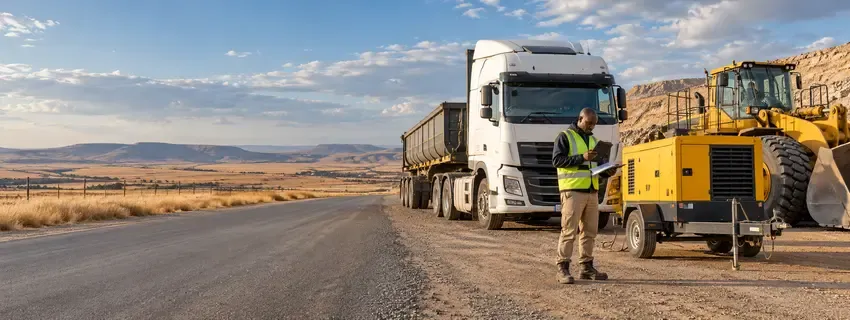
Transportation fleets, mining equipment, construction machinery, and diesel generator rental projects in South Africa often already have GPS platforms, dispatch systems, or financial processes in place. The focus of fuel monitoring is not merely to view remaining fuel levels, but to integrate fuel consumption, operating hours, routes, refueling records, and rental settlements into a single data set. This guide explains how South African projects should select equipment, determine platform integration methods, and establish pilot processes.
For the South African fuel monitoring project, the focus is not on “installing the equipment,” but on “how to use the data.”
In South Africa, many fleets and project operators are already using GPS, vehicle dispatch, maintenance management, or rental management systems.
Therefore, customers more often ask not “Can it track a location?”, but rather:
- Can the fuel level data be integrated into our existing platform?
- Can fuel consumption be tracked by project, driver, or working hours?
- For leased diesel generators, can payments be based on actual diesel consumption?
- Can vehicles in mining areas and regular road fleets be managed under a single account?
- In the event of an abnormal fuel loss, is it possible to export the location, time, and fuel level curve together?
This is also the difference between the South African project and general small fleet projects:
The equipment is merely an entry point; ultimately, it serves the purposes of management, billing, and auditing.
In which scenarios in South Africa is it appropriate to implement fuel monitoring first?
1. Long-haul fleets and regional distribution
Daily diesel expenses for transport fleets are typically substantial, as vehicles may operate across cities and provinces, with varying drivers, routes, and load conditions.
For projects of this type, we recommend focusing on the following:
- Fuel consumption per 100 kilometers;
- Changes in fuel level before and after refueling;
- Prolonged idling;
- Abnormal fuel loss while parked;
- Differences in fuel consumption between similar routes and similar vehicle models;
- Long-term fuel consumption trends for the same driver or the same vehicle.
Don’t just look at whether fuel consumption is high on a single day. It’s more valuable to compare data over several weeks or months; this is the only way to determine whether the issue stems from a mechanical problem with the vehicle, driving habits, or problems with the fueling records.
2. Mines, Quarries, and Heavy Construction Equipment
Mine trucks, loaders, excavators, drilling rigs, and water trucks have high diesel consumption, and their costs are typically calculated based on operating hours.
The most useful metrics here are typically:
- Fuel consumption per working hour;
- Fuel consumption per shift;
- Changes in fuel level after shutdown;
- Idle time;
- Do the fuel quantities match the labor hours?;
- Can the data from fixed fuel tanks and mechanical fuel tanks be reconciled?
For example, if two similar loaders are performing similar tasks and one consistently has higher-than-normal fuel consumption per hour, it’s worth checking its idle speed, load, maintenance status, or refueling records—rather than waiting until the end of the month to discover that costs have exceeded the budget.
3. Diesel Generator Rental and Temporary Power Supply
In South Africa, diesel generator rentals are common in construction, events, warehousing, and emergency power supply scenarios.
What rental companies fear most is not that the generator is just sitting there, but that when it comes time to settle the bill, both parties have conflicting accounts of “exactly how much fuel was consumed.”
Generator fuel level monitoring can help track:
- Fuel level remaining in the tank prior to rental;
- Initial fuel level upon delivery of the item;
- Generator startup and runtime;
- Hourly diesel consumption;
- Customer-reported refueling records;
- Remaining fuel level at the time of recovery.
With these records, rental companies can settle accounts based on actual consumption, operating hours, or as mutually agreed upon, thereby reducing the need for repeated explanations.
4. Construction Sites and Multi-Project Equipment Rental
Equipment rental companies frequently move machinery from one construction site to another.
If you rely solely on paper records, it’s easy to lose track of which project a piece of equipment is assigned to, how much fuel has been added, and who is responsible for the fuel costs.
We recommend managing equipment ID numbers, project names, entry and exit times, labor hours, and fuel consumption together. This way, when equipment is reassigned to the next project, fuel consumption data will not be interrupted, and it will be easier for project managers and lessors to verify costs.
How should equipment and network options be selected for the South Africa project?
Vehicles and mining equipment: Give priority to terminals that support 4G
For new projects, prioritize GPS terminals that support 4G/LTE; do not rely solely on older, lower-generation network technologies.
The specific frequency bands, SIM cards, and carrier selections should still be tested and confirmed based on the vehicle’s actual route, the location of the mining area, and the project site.
If your fleet operates across multiple regions, we recommend providing the following information to the equipment supplier first:
- Provinces and routes frequently traveled;
- Whether entering mining areas, mountainous regions, or border roads;
- Is there international shipping?;
- Is dual-SIM required?;
- Whether to use local SIM cards, IoT SIM cards, or existing corporate SIM cards.
Integration with your own platform is required: Please confirm the protocols and fields in advance.
Many customers in South Africa have their own platforms, dispatch software, or third-party systems.
Do not wait until the equipment is installed to discuss integration. The following should be confirmed before making a purchase:
- What protocols or APIs are used?;
- Which fields need to be uploaded?
- Is the fuel level expressed as the raw value, a calibrated percentage, or in liters?
- Are refueling, fuel loss, idle, and low fuel level events required?;
- Is it necessary to monitor the device’s offline status, power-off status, and external sensor status?
- Is the data sent to the manufacturer’s platform, the customer’s platform, or stored on both simultaneously?
Let’s clarify these details upfront to avoid having to revise the project later due to issues like “the location data is correct, but the fuel level field is incorrect.”
Areas with weak network coverage and remote regions: Retain local storage and the ability to upload data later
Even if the project’s internet connection is usually stable, it is not recommended to ignore offline saving.
Short-term data interruptions may occur on mining site roads, in underground parking areas, at remote construction sites, and at temporary project locations.
Therefore, it is recommended that vehicles and machinery retain the ability to store data locally and upload it later once network connectivity is restored.
For devices that are offline for extended periods, consider Bluetooth offline reading or periodic on-site export of records.
The Four Types of Reports Best Suited for the South Africa Project
1. Fleet Fuel Consumption Ranking Table
Group data by vehicle, driver, route, or project to identify those with consistently high fuel consumption.
Don’t just look at the highest single day; focus on the long-term trend.
2. Construction Equipment Operating Hours and Fuel Consumption Table
Group operating hours, idle time, fuel fill-ups, and fuel consumption together.
This spreadsheet is suitable for calculating hourly operating costs in mining, construction, and rental projects.
3. Generator Rental Settlement Form
Record the amount of fuel dispensed, refueling, operating hours, fuel consumption during the period, and the amount of fuel recovered.
This table can be used directly as the basis for communication regarding customer settlements.
4. Table of Abnormal Fuel Volume Events
Filter out abnormal fuel level decreases that occur while the vehicle is parked, with the engine off, during non-working hours, or outside project areas.
The system performs an initial screening, after which managers verify the findings based on on-site conditions; do not automatically assume that every change indicates fuel theft.
How should the pilot program for the South Africa project be implemented?
We recommend that the pilot program not be limited to just one ordinary vehicle. It would be best to cover different fuel usage scenarios at once:
- A long-haul truck;
- A piece of mining or construction equipment;
- One diesel generator for rent;
- A stationary or mobile storage tank.
The recommended pilot period is at least two to four weeks. During this period, verify:
- Is the fuel tank installation and calibration accurate?;
- Real-time online tracking of vehicles and machinery along actual routes;
- Do refueling, fuel loss, and idle events match the on-site records?
- Can the data be integrated into the existing platform?;
- Can the reports be effectively used by operations, finance, and project managers?
If we can succeed in these five areas, we can expand our installations, and future marketing efforts will go more smoothly.
South Africa Fuel Level Monitoring Pre-Purchase Checklist
- Number of vehicles, construction machinery, generators, and fuel tanks;
- Photos, dimensions, depths, and installation spaces for various types of fuel tanks;
- Is dual-SIM capability or cross-regional use required?;
- In which cities, mining areas, roads, or construction sites is the project operating?
- Do you already have a GPS platform, ERP, dispatch system, or leasing system?
- Is API, protocol, or proprietary server integration required?;
- Is fuel consumption calculated based on kilometers, labor hours, projects, or lease periods?
- Is driver identification, ACC, working hours, temperature, or other sensor data required?
- Is there someone on-site who can assist with installation, calibration, and pilot verification?
South Africa Fuel Monitoring FAQs
Can the South African fleet integrate with an existing GPS platform?
Sure. Before placing an order, we need to confirm the terminal protocol, fuel level fields, event format, and server requirements, and then arrange for platform integration or API connectivity.
How can mining machinery determine if fuel consumption is normal?
The most practical approach is to compare data by working hours, equipment type, and operational tasks. Looking solely at daily fuel consumption is not very meaningful; continuous trends provide more valuable insights.
Can generator rentals be billed based on actual diesel consumption?
Sure. Recording the amount of fuel dispensed, refueling, operating time, and the amount of fuel recovered can serve as the basis for settlement and help reduce disputes between both parties.
Which carrier’s SIM card should I choose in South Africa?
You cannot simply provide a one-size-fits-all answer for the entire country. You should first test the vehicle’s actual routes and project locations, then make a selection based on coverage, data costs, roaming requirements, and whether dual-SIM capability is needed.
If the platform shows a decrease in fuel levels, does that necessarily mean fuel theft?
Not necessarily. Road gradients, fuel tank design, temperature fluctuations, equipment maintenance, omitted refueling records, and calibration errors can all cause variations. A comprehensive assessment should be made by considering time, location, graphs, and on-site records together.
Conclusion: The value of the South African project lies in integrating fuel level data into operational and billing processes.
For fleet, mining, and oilfield equipment rental projects in South Africa, the issue is usually not a lack of a map, but a lack of data that can be used for management.
By linking fuel levels, location, operating hours, refueling data, and project information, managers can more quickly identify equipment with high fuel consumption, verify lease costs, explain discrepancies in diesel usage, and integrate the data into their existing systems.