FOFN Solutions
Fuel Level Monitoring Solutions for Backup Power Generators and Base Stations: Monitor inventory on a daily basis and ensure uninterrupted generator operation during power outages
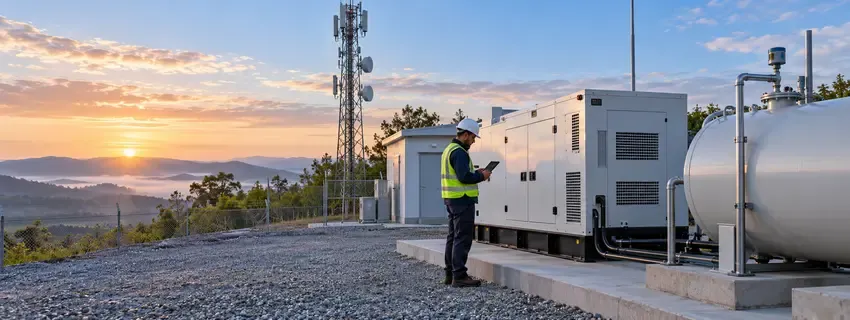
Fuel management solutions for communication base stations, data centers, backup power systems for wind and solar power plants, construction sites, and diesel generator rentals. Remotely monitor fuel tank inventory, generator start/stop status and fuel consumption trends, refueling records, and abnormal fuel loss events—ensuring backup power remains uninterrupted during critical moments and making rental billing more transparent.
Fuel Level Monitoring Solutions for Backup Power Generators and Base Stations: Monitor inventory on a daily basis and ensure uninterrupted generator operation during power outages.
Backup generator sets may go unnoticed most of the time, but they absolutely cannot fail when it really counts.
Communication base stations, IDC data centers, wind farms, solar power plants, and temporary construction sites often rely on diesel generators as backup power sources. When the mains power is stable, diesel generators often remain idle for long periods, making it easy to overlook the fuel level in storage tanks; however, in the event of a sudden power outage, operators may discover that fuel levels are insufficient, the diesel is in poor condition, or fuel consumption becomes abnormal after the generator has been running for a while—issues that can directly lead to the risk of a shutdown.
For diesel generator rental companies, another challenge is billing. Since the equipment is located at the customer’s site, it is difficult for the rental company to visit daily to check the fuel gauge. The rental company must rely on manual records or estimates based on experience regarding the customer’s reported usage, which can easily lead to disputes during settlement.
FOFN’s backup power generation and base station fuel level monitoring solution helps users remotely view generator fuel inventory, refueling records, post-startup fuel consumption curves, and abnormal fuel level changes—ensuring that backup power sources truly “start when needed and have fuel available once started.”
Applicable Scenarios
This solution is applicable to:
- Standby Diesel Generators for Communication Base Stations
- IDC Data Centers and Server Room Backup Power
- Backup power for wind farms, solar power plants, and energy storage facilities
- Temporary Power Supply for Construction Sites
- Temporary Power Supply for Outdoor Events, Trade Shows, and Performances
- Generator Rental Company
- Portable Diesel Generator Sets
- Locations in remote areas without a stable mains power supply
What are the main challenges in managing backup generators?
Since the vehicle isn’t typically started, fuel levels and fuel quality are easily overlooked.
Standby generators may remain idle for several months. While the fuel tanks may still be visible, managers are often unaware of the actual fuel level, whether there are any leaks, if fuel has been siphoned off, or if the fuel has not been replenished for an extended period.
During a sudden power outage, the biggest fear is having a generator but not enough fuel.
When the mains power fails, the generator starts up and fuel consumption increases rapidly. If fuel reserves in the storage tank are insufficient, or if fuel consumption exceeds expectations, the generator may not be able to sustain operations until mains power is restored. For communication base stations and equipment rooms, this risk cannot be overlooked.
Generators are widely distributed, and manual inspections are costly.
A carrier or leasing company may have dozens or even hundreds of generators scattered across different cell sites, construction sites, or customer locations. Manually checking fuel levels on each unit one by one is not only inefficient but also makes it difficult to detect problems in a timely manner.
Leasing billing lacks mutually agreed-upon data
Diesel engine rentals are typically billed by the day, by the hour, based on fuel consumption, or as part of a comprehensive service package. Without continuous fuel consumption records, the lessor and the customer can easily disagree on “how much diesel was actually used.”
What parts make up the proposal?
1. Fuel Tank Level Monitoring
By installing liquid level monitoring devices on fixed diesel tanks, generator-integrated fuel tanks, or mobile fuel tanks, the platform can continuously record changes in fuel levels.
Administrators can view:
- Current Fuel Level
- Historical Liquid Level Curves
- Refueling Time and Fuel Volume
- Abnormal Fuel Level Decrease During Non-Operating Hours
- Low Fuel Level Alert
- High Liquid Level Alert
- Inventory Comparison Across Different Locations
Once the fuel tanks have been calibrated, the liquid level data can be converted into more intuitive volume data, facilitating daily inventory management and refueling verification.
2. Collection of Generator Operating Status and Operating Hours
Based on the generator model and on-site conditions, the system can collect or determine the unit’s operating status, ignition status, operating duration, and start/stop times.
By combining operational status and fuel level data, we can see that:
- When does the generator start after a mains power outage?;
- How long has the unit been running continuously?;
- Is the fuel consumption curve normal during operation?;
- Does the fuel level remain stable after the unit shuts down?;
- Is there a significant difference in fuel consumption among units with the same power rating?
3. Fueling Records and Remote Verification
When the liquid level in a storage tank rises significantly within a short period of time, the system can generate a refueling event. Managers can view changes in fuel volume before and after refueling, the time of the event, and the station location, and cross-check this information with refueling slips and delivery records.
For generator rentals and remote base stations, this eliminates the need to rely solely on manual descriptions to determine “how much fuel was added, who added it, and when it was added.”
4. GPS Tracking and Site Management
Portable generators, trailer-mounted generators, and rental equipment can be paired with GPS tracking devices. Rental companies can verify whether the equipment is still at the customer’s designated location, whether it has been moved without authorization, and at which locations fuel levels have changed.
Fixed base stations or equipment rooms can also create site profiles within the platform, enabling the centralized management of multiple devices and fuel tanks by region.
5. Reminder for Long-Term Fuel Storage
Long-term storage of diesel fuel may be affected by factors such as temperature, moisture, impurities, tank sealing, microbial contamination, and fuel quality. The industry often uses approximately 12 months as a reference period for diesel storage management, but this is not a fixed standard applicable to all scenarios.
The platform can record the time of each refueling, inventory turnover, and the duration of prolonged inactivity, helping managers set up alert rules, such as:
- Fuel has not been replenished or rotated for an extended period;
- The storage tanks have been underutilized for an extended period;
- Arrange for fuel testing, filtration, rotation, or replacement before the expiration date;
- Combine on-site maintenance schedules with inspections of moisture levels, sediment, and tank condition.
Specific fuel storage periods, testing methods, and replacement requirements should be based on the fuel supplier’s recommendations, local regulations, and on-site maintenance guidelines.
What value does a fuel consumption curve have after a sudden power outage?
After the engine starts, the fuel consumption curve changes from “long-term stable” to “continuously decreasing.”
Managers can use this curve to determine:
- Has the unit been put into normal operation?;
- How long will the current remaining fuel supply last, approximately?;
- Does fuel consumption generally correspond to the unit’s load?;
- Is there abnormally rapid fuel loss?;
- Is it necessary to dispatch a fuel truck to replenish fuel?;
- When the mains power is restored, does the fuel level remain stable while the unit is shut down?
For example, if the fuel level in a base station generator has remained stable over a long period and decreases steadily after the generator has been running for 8 hours following a power outage, this is considered normal. However, if the fuel level drops rapidly while the generator is not running, or if fuel consumption during operation is significantly higher than historical levels, an immediate investigation should be conducted.
Generator Rental: How to Settle Accounts Based on Actual Usage?
Generator rentals do not necessarily have to be charged based solely on “the number of days rented.”
For projects that require accounting based on actual fuel consumption, the platform can generate clearer operational records:
- Equipment Number
- Customer or Project Location
- Arrival and Departure Times
- Generator Operating Time
- Start/Stop Log
- Starting and Ending Fuel Levels
- Refueling Records During the Period
- Actual Fuel Level Changes
- Abnormal Fuel Volume Events
Lessors and customers can verify information based on the same data record, reducing the need for verbal confirmations and minimizing disputes after the fact.
It is important to note that if the data is to be used for formal trade settlement, the contract must clearly specify in advance the measurement methods, tank calibration rules, permissible errors, fueling confirmation procedures, and dispute resolution methods.
Value of the Solution
Theft prevention, leak detection, and timely detection of abnormal fuel level changes
When the engine is not running, the fuel level should remain relatively stable. If there is a significant drop, the platform can alert management to verify the situation promptly, thereby reducing the risk of fuel theft, leakage, or unauthorized use.
Monitor fuel levels both before and after a power outage
Check inventory on a regular basis; after a power outage, check fuel consumption and remaining range. Managers do not need to wait for feedback from field personnel; they can determine remotely whether refueling is necessary.
Reduce the risks associated with fuel being left unused for extended periods
By recording refueling times and inventory turnover, the system provides a basis for reminders regarding fuel inspections, rotation, and replacement, thereby preventing diesel that has been stored for an extended period from being used directly at critical moments.
Generator rentals are billed based on actual data.
Operating duration, fuel level changes, and refueling records form a complete set of operational data, making it easier for both leasing companies and customers to accept, thereby reducing billing disputes.
Centralized Management of Multiple Sites
Fuel level data from communication base stations, equipment rooms, solar power plants, and construction sites can be viewed centrally on the platform. Managers can prioritize sites with low fuel levels, long periods of inactivity, or abnormal fuel level fluctuations.
Recommended Deployment Methods
We recommend selecting a group of representative sites for a trial run:
- 3–5 communication base stations or construction sites
- 1 stationary backup generator
- 1 mobile or rental fuel dispenser
- 1 site with a standalone fuel tank
- 1 Common Fuel Delivery Route
First, complete the fuel tank calibration, set the low-fuel threshold, verify the on/off status, and review the refueling process. After the system has been running for a period of time, configure differentiated early warning rules based on the power output, load, and importance of each unit.
Frequently Asked Questions
Is it necessary to monitor the fuel level of a standby generator that is not normally in operation?
It is necessary. Precisely because these systems are not frequently activated, issues such as fuel theft, tank leaks, and prolonged fuel stagnation are more easily overlooked. Continuous monitoring allows managers to detect problems before a power outage actually occurs.
Can the system determine how much fuel a generator has used after it starts up?
Analysis can be conducted by combining changes in fuel tank levels with unit operating time. After the fuel tanks are calibrated, the platform can provide data on fuel level changes during operation for daily management and verification purposes.
Is diesel that is more than 12 months old definitely unusable?
Not necessarily. How long diesel can be stored depends on fuel quality, tank sealing, temperature and humidity, moisture content, impurities, microbial contamination, and local regulations. Twelve months is merely a common management guideline and should not replace actual fuel testing and maintenance requirements.
Can diesel engine rentals be billed based on actual fuel consumption?
Yes. The system can record device operating time, refueling events, and fuel level changes, providing data for settlement between the lessor and lessee. If used for formal billing, it is recommended to clearly specify the metering method and settlement criteria in the contract.
Can remote base stations operate without an internet connection?
Solutions can be selected based on on-site network conditions. When the network is temporarily unstable, some devices can temporarily store data and transmit it once the network is restored; in areas with no network coverage, solutions involving local storage or short-range data retrieval should be evaluated.
Can both stationary fuel tanks and mobile generators be managed at the same time?
Yes. You can create separate records for fixed fuel tanks, on-board fuel tanks on generators, and trailer-mounted portable generators, and manage them on the same platform by site, region, or customer project.