FOFN Guides
Algeria Fuel Monitoring Guide: How to Manage Diesel in Desert Transportation, Remote Construction Sites, and Storage Tanks?
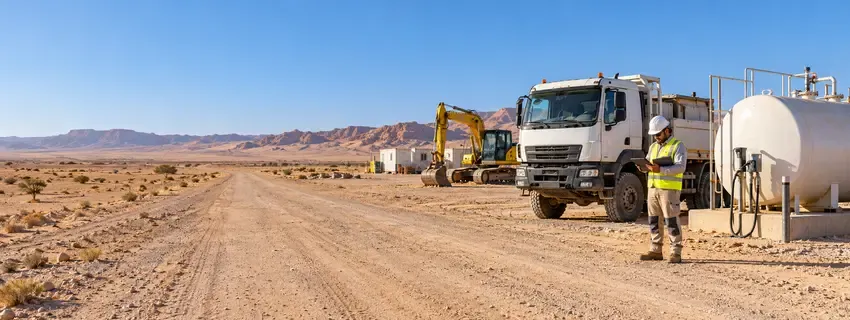
In Algeria, operating environments vary significantly across urban fleets, long-haul freight, remote projects in the south, mining areas, and fixed oil storage tanks. When implementing fuel level monitoring, it is not enough to simply check whether the equipment can connect to the network; one must also consider high temperatures, long distances, refueling stops, and network conditions. This guide explains how to select between real-time monitoring, offline data transmission, or offline data retrieval for projects in Algeria, and how to manage vehicles, construction machinery, and diesel inventory together.
For the Algeria project involving fuel level monitoring, categorize data by region first; do not categorize it solely by vehicle.
A common misconception regarding the Algeria project is configuring all vehicles in the same way.
In reality, the management requirements for urban delivery vehicles, vehicles in northern industrial zones, desert highway transport vehicles, oilfield service vehicles, and generators at remote construction sites are completely different.
Some vehicles return to a fixed parking lot every day; others need to operate on long-distance routes; and some devices may remain stationary at a site for extended periods, relying solely on diesel-powered generators.
Therefore, it would be more practical to categorize the devices into three groups before the project begins:
- Vehicles and equipment in fixed locations with good network connectivity
Ideal for real-time online monitoring of fuel levels, location, and alerts for anomalies. - Vehicles that travel on remote roads or through areas with unstable network coverage
Suitable for local storage; upload later once internet connectivity is restored. - Equipment and fuel tanks that operate long-term in locations with no internet access or minimal on-site personnel
Suitable for local storage, periodic Bluetooth readings, or a combination of manual inspections.
Choosing the right approach from the start is more important than striving for “real-time, down to the second” data right from the beginning.
In Algeria, in which scenarios should fuel management be prioritized?
1. Long-haul desert transport and project service vehicles
Trucks, pickup trucks, engineering service vehicles, and supply vehicles used in remote projects typically cover long distances, have few stopping points, and face greater challenges in arranging refueling.
Managers are often most concerned about:
- How much fuel is in the vehicle when it departs;
- Where to refuel along the way and how much fuel to add;
- Is there any unusual fuel loss when the vehicle is parked or left overnight?
- Is the data saved after the vehicle enters a remote area?
- Once back in an area with internet access, can the driving and fuel consumption records be retrieved?
For this type of vehicle, it is not recommended to rely solely on the current online status.
If a device goes offline for a short period, the most important thing is to be able to retroactively record fuel level changes and travel routes afterward, rather than seeing only a gap in the background data.
2. Machinery and equipment for oil fields, mining sites, and construction sites
Excavators, loaders, dump trucks, drilling rigs, road rollers, and diesel pumps typically operate on an hourly basis.
Their diesel costs are high, and their equipment may be scattered across different work sites.
For projects of this type, we recommend focusing on the following:
- Hourly fuel consumption;
- Fuel consumption per shift;
- Changes in fuel levels after equipment shutdown;
- Idle time;
- Can the fuel volume and labor hours be reconciled?;
- Long-term fuel consumption differences among devices of the same model.
Don’t just ask, “How many liters were used today?”
What’s even more valuable is: how many hours the device has been in operation, what tasks it has completed, and whether its fuel consumption is abnormal compared to similar devices.
3. Fixed Fuel Tanks and Temporary Diesel Refueling Points
At remote construction camps, mining sites, warehouses, or project sites, diesel is often first stored in permanent or temporary storage tanks before being used to refuel vehicles, machinery, and generators.
If fuel tank records are missing, it will be difficult to reconcile the accounts, no matter how accurate the subsequent fuel consumption data may be.
For fuel tank management, focus on the following:
- Current inventory;
- Changes before and after refueling;
- Remaining fuel volume after each refueling;
- Abnormal drops during nighttime or non-working hours;
- How many more days of use are expected?
For project managers, this not only prevents diesel loss but also avoids having to arrange for refueling at the last minute after the tank runs dry, which could disrupt construction or power supply.
4. Backup Generators and Temporary Campsite Power Supply
Remote construction sites, temporary office areas, communication facilities, and project camps may all rely on diesel generators.
This type of equipment is often overlooked in everyday use, but problems become immediately apparent during actual power outages or fuel shortages.
We recommend prioritizing the following data:
- Current fuel level;
- Low Fuel Alert;
- Generator startup time;
- Operating hours;
- Fuel consumption during operation;
- Alerts for prolonged inactivity or prolonged lack of refueling.
This allows for earlier scheduling of refueling and maintenance, rather than waiting until the equipment is down to address the issue.
How should the Algeria project address high-temperature and fuel level data?
In high-temperature regions, fuel management, equipment installation, and calibration require extra care.
Fuel level data is affected by factors such as tank shape, parking slope, refueling speed, temperature changes, and vehicle movement.
Therefore, the project should not focus solely on figures at a single point in time, but rather on fuel level curves and ongoing changes.
For example:
- If a vehicle is parked on a slope, the fuel level reading may fluctuate briefly;
- Data may vary slightly when the fuel tank is exposed to sunlight;
- After refueling, you need to look at the entire curve, not just a single data point;
- When determining whether fuel loss is abnormal, consider whether the vehicle is parked, whether the engine is off, and whether the location is normal.
Simply put, the value of the system lies in recording changes so that managers have a basis for verification, rather than automatically drawing conclusions about every change.
How should we choose the data upload method for the Algeria project?
Method 1: Real-time Online Monitoring
Suitable for urban fleets, fixed industrial zones, warehouse distribution, and routes with proven network stability.
Can be used to view:
- Current fuel level;
- Vehicle location;
- Time and location of refueling;
- Abnormal Fuel Loss Alert;
- Daily fuel consumption, mileage, and idle time.
If managers need to address anomalies promptly, real-time online monitoring is the most direct approach.
Option 2: Save offline; upload later after service is restored
Ideal for vehicles that travel to remote areas, on desert roads, or in areas with unstable network coverage.
When offline, the device first stores fuel levels, location, and events, then transmits this data once it reconnects to the network.
This approach is particularly well-suited for vehicles used in long-haul projects, as the occasional inability to view the latest location in the backend does not necessarily mean data loss.
The specific data retention period, upload intervals, and SIM card performance should be tested along actual routes during the pilot phase.
Method 3: Local Storage + Periodic Bluetooth Reading
Suitable for devices in locations where a stable cellular network is not available long-term, but field personnel can periodically visit the equipment for inspections.
For example, in the case of remote generators, standalone fuel tanks, and mining machinery, fuel levels, refueling records, and abnormal changes can first be stored within the device.
On-site supervisors then use their mobile phones’ Bluetooth to periodically retrieve data for weekly reports or monthly reconciliations.
It is not suitable for real-time alerts that require immediate action, but it is ideal for projects where “records must be kept even without an internet connection.”
For the Algeria project, which types of equipment should be piloted first?
Do not roll out the system fully during the initial deployment; we recommend selecting four representative categories:
- A long-haul truck or project service vehicle;
- One piece of construction equipment;
- One backup diesel generator;
- A fixed or temporary storage tank.
After a two- to four-week pilot period, focus on the following checks:
- Are fuel tank and storage tank calibrations accurate?;
- Vehicle performance on actual routes;
- Have the offline records been uploaded as expected?
- Do factors such as high temperatures and parking gradients affect daily assessments?;
- Can the platform data be reconciled with fuel receipts, labor hours, and inventory records?
If these elements work as intended, we can then scale them up to the entire project, which will significantly reduce the need for subsequent adjustments.
Algeria Fuel Level Monitoring Pre-Purchase Checklist
- Number of vehicles, construction machinery, generators, and fuel storage tanks;
- Photos of fuel tanks and reservoirs, depth, shape, and installation space;
- Whether the project is in a city, an industrial zone, on a long-distance highway, in a mining area, or at a desert construction site;
- The vehicle’s regular routes and expected parking locations;
- Are there conditions such as high temperatures, intense sunlight, dust, or prolonged parking?;
- Do you already have a GPS platform, dispatch system, or your own server?;
- Is API or protocol integration required?
- Do you require real-time alerts, daily reports, weekly reports, or monthly inventory reports?
- Is there anyone available to perform regular Bluetooth data collection for remote projects?
- Is assistance from local technical personnel required during installation?
Algeria Fuel Monitoring FAQs
Can fuel levels still be monitored on remote desert roads in Algeria where there is no internet connection?
Yes. Vehicles can choose to save data offline and upload it later once network connectivity is restored; for devices and fuel tanks that are offline for extended periods, you can choose to store data locally and retrieve it periodically via Bluetooth on a smartphone.
Could high temperatures cause fuel level monitoring data to be inaccurate?
High temperatures, gradients, and fuel tank design can all cause short-term fluctuations; therefore, judgments should be based on installation calibration and continuous trends, rather than relying solely on a single instantaneous reading.
Can storage tanks and vehicle fuel tanks be managed together?
Yes, and we recommend managing them together. When fuel tank inventory, vehicle refueling, and equipment consumption align, the flow of diesel becomes much clearer.
Which carrier’s SIM card should be used in Algeria?
It is not recommended to base your selection solely on a nationwide scope. Field tests should be conducted in project cities, along southern routes, at mining sites, and at parking locations before determining the appropriate local SIM cards, IoT cards, or multi-network solutions.
If the platform indicates a drop in fuel levels, does that necessarily mean fuel theft?
Not necessarily. Vehicle incline, oil drains during maintenance, sensor calibration, omitted refueling records, and temperature fluctuations can all affect the data. Verification should be conducted comprehensively, taking into account time, location, parking status, and fuel level curves.
Conclusion: For remote projects, the first priority is to ensure that “data can be retained.”
For the fuel monitoring project in Algeria, the key is not to promise real-time online access everywhere, but rather to select the appropriate data transmission method based on the region where the vehicles and equipment are located.
Cities and fixed lines can be managed in real time;
Vehicles operating in remote areas should be capable of saving data offline and transmitting it later;
For fuel tanks and equipment that are offline for extended periods, local data must be retained and retrieved periodically.
As long as refueling, inventory, labor hours, and fuel consumption figures match up, diesel management can transition from manual estimates to a system with verifiable records—even for projects in remote locations or complex environments.