FOFN Guides
Guide to Fuel Monitoring for Mines, Plantations, and Engineering Projects in Indonesia: How Should Diesel Be Managed When Projects Are Dispersed?
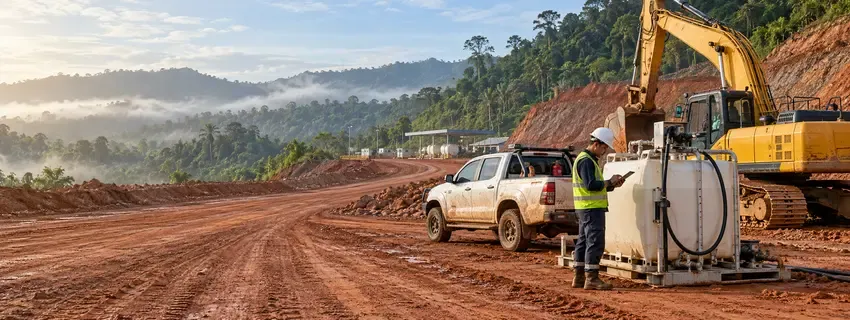
In Indonesia, mines, plantations, construction projects, and inter-island transportation often involve long distances, dispersed vehicles, and varying network conditions. When implementing fuel monitoring, the priority is not to purchase equipment first, but to first determine which vehicles require real-time online monitoring, which areas require data to be uploaded later, and which remote sites are suitable for offline data collection via Bluetooth. This guide compiles common management approaches, pilot methods, and procurement checklists for implementing projects in Indonesia.
For the fuel monitoring project in Indonesia, don’t rush to ask, “Will the equipment work?”
This is acceptable, but your response cannot consist solely of this sentence.
When many customers make their first inquiry, they often ask directly, “Can your fuel level sensors and GPS trackers be used in Indonesia?”
A more practical answer would be:First, check where the vehicles are traveling, where they refuel, and how often the manager can visit the site.
The situations frequently encountered in Indonesian projects are fairly typical:
- Mining areas, plantations, and construction sites are located far from urban areas;
- A company may have multiple islands and multiple project sites;
- Dump trucks, excavators, loaders, generators, and fuel tanks are not located at the same site;
- Vehicles operate continuously during the day and are parked in temporary parking areas or at construction sites at night;
- Some connections are stable, while in other areas data uploads may be intermittent;
- Managers want to know not just “how much fuel is left,” but “where exactly the fuel loss occurred and whether it was recorded.”
Therefore, the core of the Indonesian fuel monitoring project is not simply installing a fuel level sensor, but rather integrating fuel levels, location, labor hours, refueling records, and on-site management processes.
Which projects in Indonesia are best suited for fuel monitoring first?
1. Mining Transportation and Mining Site Construction Vehicles
Fuel consumption for vehicles in mining areas is typically very high. Dump trucks, excavators, loaders, water trucks, and generators use diesel every day, and if records aren’t kept accurately, reconciling accounts at the end of the month can be a real headache.
Frequently asked questions include:
- The refueling amount was recorded, but it does not match the actual amount of fuel dispensed;
- When a vehicle is parked at the edge of a mining area or in a maintenance area, the fuel level suddenly drops;
- Among devices of the same model, one unit’s fuel consumption is significantly higher than the others;
- The equipment has been idling for a long time, but no one on-site can explain why;
- After the fuel tanks were delivered to the mining area, there were no continuous records of the remaining inventory.
For projects of this type, it is recommended to prioritize connecting “high-fuel-consumption equipment” and “high-risk refueling locations” to the system; there is no need to install the devices on all vehicles from the outset. Start by getting 10 to 20 key pieces of equipment up and running—this usually makes it easier to identify issues.
2. Palm Plantations, Forestry, and Agricultural Machinery
Equipment used on plantations and in forest areas covers large operational areas, and vehicles travel over extensive ranges. Tractors, harvesting equipment, pickup trucks, diesel pumps, and temporary fuel storage tanks are often distributed across different work zones.
The focus here isn’t necessarily on monitoring vehicles down to the second, but rather on ensuring the following aspects are properly managed:
- How much fuel is added to each machine each day;
- Do the operating hours and fuel consumption roughly match?;
- How much inventory is left in the temporary storage tank?;
- Is there any abnormal fuel loss after the vehicle is shut down overnight?;
- Does fuel consumption suddenly become abnormal after the equipment moves between plots?
For plantation projects, a management approach involving “daily reports + anomaly alerts” is generally more suitable. Managers can review key anomalies daily without having to constantly monitor the map.
3. Infrastructure, Road Construction, and Temporary Construction Sites
Many engineering projects in Indonesia are carried out in phases: equipment is brought to the site, operations are concentrated there, the site is changed, and the equipment is redeployed. The biggest concern with such projects is that while equipment and fuel tanks move with the construction site, the records do not keep up.
Contractors should pay particular attention to:
- Changes in fuel levels when equipment enters and exits the construction site;
- Daily working hours and daily fuel consumption;
- Incoming, outgoing, and remaining quantities of fuel in temporary storage tanks;
- Fuel loss alerts during non-operating hours;
- Records of equipment transfers between multiple construction sites.
Simply put, engineering projects aren’t just about “tracking a location”; they require project managers to be able to explain: how long this piece of equipment was in operation today, how much diesel it consumed, and why there was an unexpected increase in fuel consumption.
For the Indonesia project, should we opt for real-time online monitoring or offline data collection?
There is no single correct answer to this question. A prudent approach would be to categorize them into three types based on the vehicle and project location.
Method 1: Real-time Online Monitoring
Suitable for suburban transportation, port logistics, transportation on major highways, and construction vehicles operating in areas with relatively stable network coverage.
The devices upload data such as fuel level, location, ACC status, and travel routes to the platform. Administrators can view:
- Current fuel level;
- Refueling times and times of abnormal fuel loss;
- The vehicle’s location at that time;
- Daily fuel consumption and mileage;
- Is the vehicle idling for an extended period?
The advantage of this type of project is its rapid response. For example, if a vehicle shows a significant drop in fuel levels at night, managers can quickly verify the location, the driver, and the situation on-site.
Method 2: Low-Signal Data Upload Mode
Suitable for projects where vehicles are connected to the internet most of the time but may occasionally lose data when entering mining areas, mountain roads, or forested areas.
The devices store data locally when there is no mobile network connection and upload it once the connection is restored. As a result, data on the platform may not appear in real time every minute, but fuel level changes, tracks, and events will not be lost due to brief network outages.
Please note the following:The data recovery feature does not guarantee that “data will never be lost.” The specific retention period, upload frequency, and on-site network conditions must all be confirmed during the pilot phase.
Method 3: Offline Bluetooth Data Collection
Suitable for scenarios where there is no long-term cellular network coverage, project locations are very remote, but on-site personnel can periodically access the equipment.
For example, at remote mining sites, mountainous construction sites, or for machinery that is offline for extended periods, fuel level sensors can store records of fuel levels, refueling, and abnormal changes locally. Staff can then export the data by bringing their smartphones close to the equipment via Bluetooth.
Unlike real-time platforms, this approach does not display alerts immediately, but it is well-suited for projects that require “recording data even without an internet connection.” For management, it functions more like a “black box” for fuel data: after an incident occurs, there is at least data to review, rather than relying entirely on the driver’s verbal explanation.
For projects in Indonesia, we recommend first conducting a pilot using four types of devices.
If this is your first time implementing fuel monitoring, we do not recommend rolling it out across the entire project right away. You can start by selecting the following four categories of vehicles:
- A long-haul truck
Check whether the road network, refueling records, fuel consumption, and alerts for abnormal fuel loss match actual conditions. - A piece of mining or construction equipment
Monitor operating hours, idle time, fuel consumption during operations, and changes in fuel levels after shutdown. - A piece of equipment at a plantation or remote project site
Verify whether data resubmission over weak networks or offline Bluetooth data collection is suitable for the field. - A fixed or temporary storage tank
Check whether the data on refueling, fuel dispensing, remaining fuel levels, and inventory counts match the manual records.
The pilot phase can initially run for two to four weeks. Do not simply check whether location points appear on the map; instead, cross-reference the data with actual fuel receipts, driver logs, equipment operating hours, and fuel tank inventory. Only if the data matches will it make sense to expand the installation later.
The Five Most Important Data Categories for the Indonesia Project
Many platforms have a lot of data, but the five categories listed below are typically the only ones that administrators actually need to review each day:
1. Current Fuel Level and Low Fuel Level Alerts
This is the most basic data. It is particularly important for generators, construction machinery, and vehicles used in remote projects, as it allows for advance fuel replenishment to prevent equipment downtime due to running out of fuel.
2. Fueling Records
This includes refueling times, changes in fuel levels before and after refueling, and vehicle locations.
With this data, managers can verify fuel receipts rather than relying solely on a handwritten document.
3. Records of Abnormal Fuel Loss
If fuel levels drop rapidly while the vehicle is parked, turned off, or during non-operational hours, the system can use this as a basis for issuing an alert.
However, please make it clear that:An alert for abnormal fuel loss does not constitute proof of fuel theft. This must also be evaluated in conjunction with the fuel tank design, road gradients, refueling records, on-site operations, and vehicle location.
4. Labor Hours and Fuel Consumption
For excavators, loaders, diesel pumps, and generators, tracking fuel consumption on an hourly basis is generally more informative than simply looking at “how many liters were used per day.”
5. Fuel Tank Inventory
Whenever a project involves temporary fuel depots or storage tanks, vehicle fuel consumption and fuel tank outbound shipments must be analyzed together.
Monitoring only the vehicle and not the fuel tank still makes it easy to end up with the question, “Where exactly did the fuel go missing?”
Pre-Procurement Checklist for the Indonesia Fuel Level Monitoring Project
Before confirming the equipment, we recommend that customers have the following information ready:
- How many vehicles, pieces of machinery, and storage tanks are there, respectively?
- The fuel tank size, shape, and installation location for each device;
- On which island, in which city, at which mining site, or on which plantation do the vehicles primarily operate?
- Are there any routes or sites where there is frequently no internet connection?
- Do you need real-time access, or is a daily report sufficient?
- Do you already have your own GPS platform or management system?
- Do you need API integration, protocol integration, or direct upload to your own server?
- In which scenarios are concerns about fuel theft, falsified refueling records, or excessively high fuel consumption most prevalent?
- Are there installation technicians on-site, or is remote guidance required for installation and calibration?
The more complete this information is, the more accurate the initial recommendations for equipment and data models will be. In particular, do not make assumptions about fuel tank sizes, project locations, and network conditions.
Frequently Asked Questions (FAQ) on Fuel Monitoring in Indonesia
Can fuel level sensors be installed on trucks, mining vehicles, and construction machinery in Indonesia?
Installation can be evaluated for most diesel vehicles and machinery, but the fuel tank material, depth, internal structure, mounting hole locations, and power supply conditions must be confirmed first. The same installation method cannot be directly applied to different fuel tanks.
Is it possible to manage fuel levels in remote mining areas in Indonesia where there is no stable internet connection?
Sure. For projects with unstable internet connections, consider saving data offline and uploading it later once the connection is restored; for sites with no long-term internet access, you can opt for devices with local storage that allow data to be retrieved via Bluetooth from a smartphone. The specific choice depends on how frequently personnel visit the site.
Which mobile carrier’s SIM card is best in Indonesia?
Do not rely solely on national standards. Conditions may vary across cities, islands, mining areas, roads, and indoor parking areas. We recommend testing signal coverage along the actual project route before deciding on a local SIM card, roaming IoT SIM card, or multi-network solution.
If fuel levels drop suddenly, does that mean the driver is stealing fuel?
Not necessarily. Fuel level fluctuations can result from factors such as a tilted fuel tank, driving uphill or downhill, omitted refueling records, uncalibrated sensors, or draining fuel during equipment maintenance. The platform’s role is to provide time, location, and trend data to facilitate management reviews, rather than to draw direct conclusions for anyone.
We already have our own platform. Can we still integrate with yours?
The integration method can be confirmed before the project begins. If the client has their own platform or server, evaluate API or protocol integration options based on the protocols and data formats supported by the devices, as well as project requirements.
Conclusion: First, ensure the data for key projects is working properly, then scale up.
The biggest challenge in Indonesian projects is usually not whether “there is a GPS device available,” but rather the vast differences in vehicles, islands, project sites, and network conditions.
A prudent approach would be:
First, select a representative sample of mining trucks, construction machinery, plantation equipment, and oil storage tanks for the pilot program; begin by reconciling fuel levels, refueling records, abnormal fuel loss, operating hours, and inventory; then, based on on-site network conditions, determine whether to use real-time online transmission, data upload over weak networks, or offline data collection.
This approach to fuel management goes beyond simply looking at maps; it truly helps project managers reduce reconciliation time, identify anomalies, and schedule refueling.