FOFN Industries
How to manage diesel consumption on construction sites without internet access and in remote areas
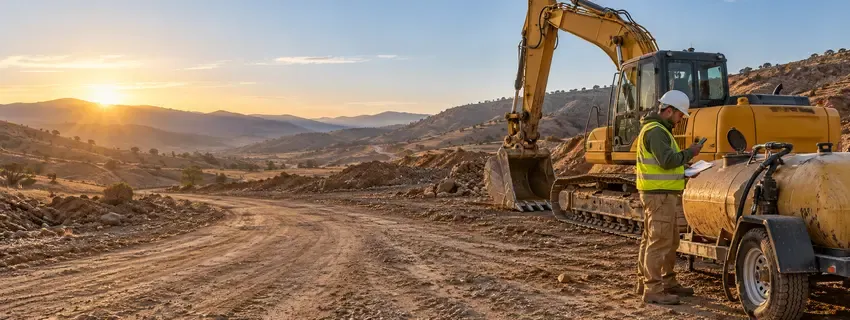
In remote mining areas, mountainous construction sites, and temporary construction camps where stable 4G networks are unavailable, the fact that managers cannot check fuel levels from the office at any time does not mean that diesel cannot be managed. The key is to establish a work routine of “on-site record-keeping, periodic data collection, and monthly reviews” to document refueling, fuel consumption, and any unusual changes.
How to manage diesel consumption on construction sites without internet access and in remote areas
Many construction sites aren’t lacking equipment—they lack internet access.
When roads extend into mountainous areas, construction crews set up in remote regions, mining sites are located in deserts or forested areas, or temporary camps are far from urban centers—in these scenarios, cell phone signals can be intermittent, and sometimes there is no stable cellular data connection at all. Managers often face a practical problem: while the equipment and fuel tanks are on-site, the office cannot view real-time fuel levels.
In this context, “no internet” should not be interpreted as “unmanageable.”
We just need to adjust the management approach. For projects with stable internet connections, issues can be viewed and addressed in real time; for projects with no internet or weak signals, it is more appropriate to useRecord on-site data, collect data periodically at the equipment location, and conduct post-analysis based on the logbook.method.
While it is not a substitute for real-time remote monitoring, it can already resolve many day-to-day issues for remote projects: whether refueling has been logged, whether there has been an abnormal drop in fuel levels during downtime, and whether equipment operation and diesel consumption are generally reasonable.
Let’s clarify the expectations first: In an offline environment, the data is not viewed in real time but is checked periodically.
The most common misconception at construction sites without internet access is the expectation that all changes can be viewed in real time from the office.
If no network is available on-site, managers should not expect the system to meet real-time alert standards. A more realistic goal is:
- Ensure that changes in fuel levels are recorded on-site;
- Enable the review of refueling, normal consumption, and abnormal changes;
- Have project managers collect data regularly using their mobile phones or inspection devices;
- Put an end to relying solely on drivers’ verbal reports for monthly diesel accounting.
In other words, the focus of offline fuel level management is on “evidence-based review,” rather than pretending to provide real-time online monitoring.
For projects in remote areas, as long as these boundaries are clearly defined, management actually becomes easier to implement.
Which types of sites are best suited for this management approach?
Diesel management in areas with no or weak network coverage is commonly encountered in the following scenarios:
- Mountain road construction and water conservancy projects;
- Remote mining areas, sand and gravel yards, and quarries;
- Field exploration, camps, and temporary project offices;
- Large farms, forest areas, and remote irrigation projects;
- Temporary diesel generator and construction equipment rental project;
- Communications, power, and energy facilities located far from towns.
These projects share several common challenges: equipment is scattered across multiple locations, manual inspections are costly, diesel expenses are significant, and in the event of a dispute, it is difficult to provide a clear explanation on-site immediately.
First, establish a simple “data collection schedule.”
For projects without internet access, it is not practical to require field personnel to generate a large volume of reports every day; ultimately, no one will stick with it.
A practical approach is to first establish a consistent rhythm. For example:
- Key equipment is inspected once a week by the project machinery supervisor;
- After each refueling, keep a simple record of the refueling;
- Schedule a centralized data collection and diesel review once a month;
- For equipment showing abnormal fuel level fluctuations or high diesel costs, increase the frequency of inspections.
If fuel monitoring equipment with local data logging capabilities is used, on-site personnel can view and export the logs via their mobile phones while near the device. The data collection frequency should be shorter than the period for which the device can store data; specific settings depend on the actual configuration, project risks, and on-site management requirements.
Data collection doesn’t need to happen every day, but the data shouldn’t go unchecked for months at a time. Once a routine is established, even remote projects can generate a continuous data stream.
When managing diesel, don’t just look at how much you’ve added—look at how much work it’s done.
A common management practice at remote construction sites is as follows: a fuel truck delivers the fuel, the driver signs for it, and the project office records the transaction.
This only tells you how much fuel was purchased; it does not indicate where that fuel was used.
A more useful approach is to view diesel records and field operations together:
- How many hours has this excavator been in operation this month?;
- How many trips has this construction vehicle made, and which construction site did it serve?;
- During what time periods does the generator operate under load?
- How much fuel was refilled into a certain mobile storage tank;
- After refueling, does the fuel level displayed on the device change accordingly?
There’s no need to be overly precise with the calculations right from the start. Simply ensuring that refueling, operation duration, and fuel level changes generally correspond will already reveal many management loopholes.
The Three Most Common Types of Problems at Remote Construction Sites
1. Refueling is recorded, but the device’s fuel level doesn’t match.
This could be due to inaccurate recording times, incorrect fuel volume entries, or the shape of the equipment’s fuel tank affecting readings; it could also be that not all of the fuel actually entered the equipment. When this happens, don’t just ask “who refueled it”; first cross-reference the refueling time, the equipment’s status, and subsequent changes in fuel volume.
2. A significant drop in fuel levels occurred during the shutdown period.
Equipment parked at remote construction sites, material yards, or temporary camps is often left unattended at night. If unexplained changes in fuel levels occur during work stoppages or non-operational hours, the project manager should prioritize verifying the on-site situation during the next inspection.
This does not necessarily indicate that fuel theft has occurred. Maintenance, fuel transfers, equipment relocation, or omissions in record-keeping are all possible causes. The purpose of the data is to alert managers that this issue requires further investigation.
3. Total diesel expenses are very high, but no one knows which piece of equipment is causing the high consumption.
At the end of the month, the project department only knows that fuel expenses have exceeded the budget, but they don’t know whether the problem lies with the excavators, generators, transport vehicles, or mobile fuel tanks.
By recording device data separately, you can first identify those with significantly higher consumption. The next step is to analyze this data in conjunction with work assignments, labor hours, and on-site workload—a much more effective approach than having everyone “guess the cause” together.
What should the on-site supervisor do when there is no internet connection?
Whether an off-network project can be managed effectively does not depend on how attractive the reports are, but rather on whether the on-site manager follows a consistent set of procedures.
We recommend that project managers incorporate the following four tasks into their routine work:
- Record fueling: Clearly record the equipment, date, amount of fuel dispensed, and operator;
- Work Log: At a minimum, retain the approximate labor hours, shifts, or construction tasks;
- Regular data collection: Read the records at the equipment or fuel tanks at specified intervals;
- Monthly Review: Cross-check refueling, fuel level changes, and operational status together.
These steps may seem simple, but if you stick with them consistently for two or three months, diesel management at the construction site will become much more transparent than before.
Don’t wait until the end of the month to discover the problem.
The biggest challenge for remote projects is having to wait until the end of the month to compile fuel receipts.
Because so much time has passed—drivers have rotated shifts, equipment has been relocated, and fuel trucks have been reassigned to other projects—many details are now difficult to verify. A more practical approach is to review recent records during each inspection and clarify any anomalies as soon as they are discovered.
For example:
- Over the past week, fuel levels have been dropping much faster than usual;
- There is a refueling record, but the fuel level on the device has not increased as expected;
- The equipment has not been used for a long time, yet significant changes have occurred;
- Among similar devices, one unit has a significantly higher fuel consumption per man-hour.
The sooner these issues are addressed, the easier it will be to obtain accurate answers.
For diesel expense tracking in remote projects, we recommend conducting monthly reviews as follows:
Each month, the project department can prepare a simple inventory list by device:
- Equipment name or number;
- This month’s operational area:
- Monthly fuel consumption;
- Approximate total working hours this month;
- Changes in fuel levels;
- Have any events requiring verification occurred?;
- Confirmed causes and resolution.
If the project also involves mobile fuel tanks, list them separately and record the fuel intake, output, and on-site remaining quantity. This allows for separate management of “fuel in the tanks” and “fuel in the equipment,” making subsequent reconciliation clearer.
The value of offline management is that it ensures even remote construction sites have records that can be accessed.
While an unstable network connection does indeed reduce real-time performance, it does not mean that management capabilities are lost.
For many remote construction crews, mining sites, and temporary projects, the most important thing isn’t seeing data every minute—it’s preventing diesel fuel from becoming a completely “unaccounted-for” expense.
As long as there is a fixed data collection cycle on-site, along with fueling records and equipment operation logs, managers will gradually be able to determine:
- Which device consumes the most fuel?;
- Which project has abnormal diesel costs?;
- During which time period were there fuel level changes that require explanation?
- Where should we prioritize inspections next month?
This alone can help businesses significantly reduce unnecessary losses and disputes.
Frequently Asked Questions
Can I still check fuel levels in real time from the office without a 4G network?
Stable, real-time monitoring is generally not feasible. In scenarios without internet access, local recording and periodic data collection are more suitable, with the focus on the ability to review and verify data retrospectively rather than on real-time remote alerts.
How often is it best to collect data?
Decisions should be based on the device’s local data retention period, project risks, and inspection conditions. As a general rule, data collection should not exceed the device’s data retention period; for projects with high diesel consumption or high personnel turnover, the data collection frequency should be increased.
After collecting and recording data with a mobile phone, what information will be visible?
Specific features depend on the device configuration and usage. Typically, the system can be used to view fuel level changes over a period of time, refueling records, and unusual changes that require verification; actual display items are subject to the product configuration.
Does an abnormal change in fuel levels directly prove that someone is stealing fuel?
No. Unusual changes only indicate that this period requires closer scrutiny; a judgment must also be made by considering construction, maintenance, fuel transfer, and refueling records, as well as on-site conditions.
Is it really necessary to manage just a few excavators at a remote construction site?
It is necessary. Diesel refueling and manual inspection costs are higher for remote projects, and once management oversights occur, they are often more difficult to detect. Even if there is only a small number of devices, it is recommended to start by recording refueling, labor hours, and changes in fuel levels.