FOFN Industries
How Open-Pit Mines Can Use Fuel Consumption Per Metric Ton of Ore to Identify Low-Productivity, High-Consumption Equipment
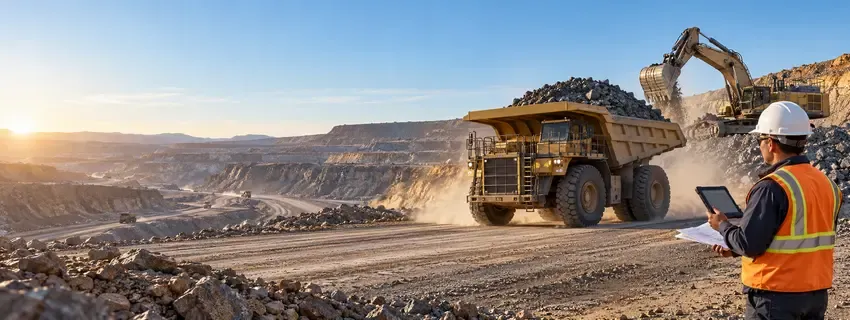
Mining trucks, loaders, and excavators consume large amounts of diesel daily, but simply looking at “how much fuel was added today” does not indicate equipment efficiency. By analyzing fuel consumption, operating hours, and transport volume together, mine managers can identify issues such as low productivity and high consumption, prolonged downtime, and abnormal fuel usage at an earlier stage.
How Open-Pit Mines Can Use Fuel Consumption Per Metric Ton of Ore to Identify Low-Productivity, High-Consumption Equipment
When tracking diesel consumption for mining equipment, it’s not enough to simply look at how much fuel a single vehicle refueled today.
It’s perfectly normal for a mining truck to consume a little more fuel when it makes a few extra trips or climbs a few more hills; similarly, a loader handling hard materials for extended periods will consume more fuel than one handling loose gravel and sand. What truly warrants management isn’t the fuel gauge reading on any given day, but rather:How much effective work was accomplished with this fuel?
For open-pit coal mines, metal mines, stone quarries, and sand and gravel aggregate yards, the most meaningful metrics are typically:
- How much fuel is consumed per working hour;
- How much fuel is consumed per metric ton of ore?;
- How much fuel is consumed per metric ton of stripped material?;
- Are the differences in fuel consumption and output becoming increasingly significant among similar devices?
- Even though the equipment is clearly on-site, how much time is spent waiting, idling, or running idle?
By combining this data, it becomes easier to identify equipment with low productivity and high energy consumption.
Why Do Mining Operations Fear “High Fuel Consumption Without a Clear Cause” the Most?
High fuel consumption in mining equipment does not necessarily indicate a problem with the equipment.
Sometimes it’s due to longer distances, sometimes to poorer road conditions, sometimes to waiting in line to load or unload, and sometimes to slippery roads during the rainy season—all of which require vehicles to use more power to complete the same transport task. Looking solely at diesel consumption can easily lead to misjudgments.
Conversely, however, if one relies solely on on-site explanations, it is easy to gloss over the real issues.
For example, if two mining trucks of the same model—operating on similar routes, with similar payloads, and on similar schedules—show that one consistently has higher fuel consumption per metric ton of ore over several weeks, or if there is a significant difference in fuel consumption per hour, this warrants further investigation. The issue may stem from equipment maintenance, driving habits, idle time, or scheduling arrangements; it could also be due to a lack of complete correspondence between production data and fueling records.
Therefore, fuel consumption management in the mining industry is not simply a matter of “keeping an eye on fuel,” but rather transforming fuel consumption into a metric that aids in production management.
First, look at “fuel consumption per hour,” then look at “fuel consumption per metric ton of ore.”
These two metrics must be considered together; you cannot look at just one of them.
Hourly fuel consumption: Check whether the device is consistently operating at high consumption levels.
Hourly fuel consumption is a good indicator of the device’s operating status.
A sudden increase in fuel consumption per hour for a single unit may indicate that it is operating under heavy loads, on steep gradients, or during high-intensity operations; it could also be due to prolonged idling, changes in engine condition, or inefficient on-site scheduling. Monitoring data over a continuous period provides more meaningful insights than looking at a single day’s data.
Fuel Consumption per Metric Ton of Ore: See if These Fuels Are Paying Off in Terms of Output
When evaluating fuel consumption per metric ton of ore, it is more appropriate to consider overall efficiency.
If a mining truck consumes a significant amount of fuel each day but also transports a high tonnage, this isn’t necessarily a bad thing; conversely, if fuel consumption hasn’t decreased significantly but the volume of cargo transported continues to decline, this warrants attention.
For different types of minerals, calculations can be based on actual production volumes:
- Coal mines can view fuel consumption per metric ton of coal;
- For metal ores, you can view the corresponding fuel consumption per metric ton of raw ore or concentrate;
- Stone quarries and sand and gravel aggregate yards can view the volume per metric ton of stone, per metric ton of aggregate, or per truckload;
- For stripping operations, refer to the fuel consumption per metric ton of stripped material.
As long as the data is recorded consistently over a period of time, trends can be identified.
Low productivity and high consumption are usually caused by these situations
1. The equipment has been running continuously, but the effective output is low.
Mining trucks, loaders, or excavators may appear to be in motion, but in reality, they are waiting to be loaded, to be weighed, to unload, or for the road to clear.
In this scenario, hourly fuel consumption may not seem particularly excessive, but fuel consumption per metric ton of ore will gradually increase. Managers need to look beyond whether the equipment is turned on; they need to determine exactly what percentage of the time the equipment is actually in operation.
2. The gap between similar devices is widening.
For equipment of the same model, assigned to the same crew, and operating on similar routes, fuel consumption should naturally fall within a reasonable range.
If one of the devices consistently shows elevated readings, do not immediately assume it is the driver’s fault. First, determine whether the vehicle is carrying a heavier load, then inspect the tires, engine, hydraulic system, road conditions, and maintenance records. This approach makes it easier to identify the true cause and avoids unfairly blaming the on-site personnel.
3. Road conditions and scheduling have changed, but fuel consumption standards have not been adjusted accordingly.
The rainy season, changes in transport distances, deeper mining operations, and increased slopes can all affect fuel consumption in mining areas.
Some mines continue to evaluate current equipment against outdated standards, resulting in a perception of unfairness on the ground while management feels that fuel consumption is out of control. A more reasonable approach is to group equipment by mining area, transport route, shift, and task type, applying different reference ranges for different operating conditions.
4. Fuel consumption has increased significantly, but production has not kept pace.
Situations like this are the most worth reviewing.
First, verify the fuel logs, equipment operating hours, production tonnage, and downtime records; then check for equipment malfunctions, prolonged idling, frequent relocation, or unscheduled operations. Cross-referencing these records item by item is typically far more effective than examining a single fuel receipt on its own.
Hold daily team meetings; it is recommended to focus on just three things.
Mine management is very busy, and no one has time to go through a lot of reports every day. In fact, it’s enough to check just three things before a shift or during a shift handoff:
- Which devices had significantly higher hourly fuel consumption yesterday?;
- Which work crew or transport route has experienced a sudden change in fuel consumption per metric ton of ore?;
- For which devices do the refueling, downtime, or production records not match?
First, identify the devices showing anomalies, then have the on-site supervisor explain the situation based on actual conditions. This approach ensures that the focus isn’t lost amid an overwhelming amount of data.
Using data for post-trip analysis is not meant to cause trouble for drivers.
Mining operations take place in complex environments, so it is not possible to determine who is at fault based solely on a single fuel consumption curve.
A best practice is to treat fuel consumption data as the “starting point for identifying issues.” It alerts managers to questions such as: Why is this vehicle consuming more fuel than usual? Why has efficiency on this route declined recently? Has the wait time for this work crew increased?
Ultimately, reliable conclusions can only be drawn by taking into account actual on-site conditions: weather, road conditions, load, maintenance, production schedules, and personnel assignments.
The benefit of this approach is that diesel management is no longer just the responsibility of the finance or fuel management staff; instead, it helps the dispatch, equipment, and production departments work together to clarify issues.
Is it still possible to analyze fuel consumption in mining areas where there is no stable internet connection?
Yes, but be sure to distinguish between “periodic verification” and “real-time remote management.”
In some remote mining areas, underground sites, or goafs, there is no stable cellular network, making it impossible for managers to view real-time data from their offices at any time. In such scenarios, the focus should be on shift logs, fueling records, production tonnage, and periodically exported fuel consumption records—starting with monthly and weekly fuel consumption reviews.
If you need to know how to store fuel level, refueling, and abnormal drop records in areas without internet access, please refer to the “Fuel Level Monitoring Solution for Areas Without Internet Access” on our website. It is designed to address data retention issues at remote construction sites or mining areas where a stable internet connection is unavailable.
A single monthly report is all it takes to identify the key equipment.
We recommend creating a simple monthly summary table for each piece of equipment, including at least the following items:
- Equipment ID and model number;
- Actual working hours;
- Monthly fuel consumption;
- Estimate fuel consumption for this month;
- Transport volume, production volume, or extraction volume;
- Hourly fuel consumption;
- Fuel consumption per metric ton of ore;
- Incidents and verified causes.
Don’t try to make things overly complicated right from the start. First, ensure the data is consistent and standardized. After three months, it will usually become clear which devices are stable and which ones need to be checked.
Which mining companies are suitable for this type of management?
This type of fuel consumption management system for mines is suitable for:
- Open-pit coal mine;
- Metal mining companies;
- Stone quarries and sand and gravel aggregate yards;
- Large-scale mining sites equipped with mining trucks, loaders, and excavators;
- Mining contractors with a large fleet of owned equipment and significant diesel procurement volumes;
- Mining companies that manage multiple mining areas and multiple work crews simultaneously.
Even if you don’t have a large number of devices, it’s still worth comparing fuel consumption, labor hours, and output if your monthly diesel costs are high. Many efficiency issues aren’t revealed by a single inventory check but gradually become apparent through data comparisons over several weeks or months.
Frequently Asked Questions
Should fuel consumption for mining equipment be calculated by the hour or by metric ton of ore?
We recommend monitoring both metrics. Hourly fuel consumption is useful for assessing the device’s operational status, while fuel consumption per metric ton of ore is better suited for evaluating production efficiency. Relying on only one of these metrics can lead to misinterpreting normal heavy-load operations as abnormal fuel consumption.
Can fuel consumption be directly compared across different models of mining trucks and loaders?
Direct comparisons are not recommended. Data should be grouped by device model, task type, transport route, and load conditions. When making comparisons, it is more appropriate to examine trends among similar devices operating under comparable conditions.
Does an increase in fuel consumption per metric ton of ore necessarily indicate a equipment malfunction?
Not necessarily. It could be due to longer transport distances, poorer road conditions, the rainy season, increased wait times, or adjustments to the production schedule. Equipment failure is just one possibility; a determination must be made by considering labor hours, output, and on-site records together.
There is no 4G network in the mining area. Is it possible to view fuel consumption in real time?
When a stable internet connection is unavailable, this should not be treated as a fully functional real-time remote management scenario. However, fuel consumption verification and monthly reviews can still be conducted using on-site records and periodically exported data. When real-time alerts are required, verify on-site network coverage first.
Is it worth implementing fuel consumption management for just a dozen or so pieces of equipment?
It’s worth it. Although small mining sites have fewer pieces of equipment, diesel expenses often account for a significant portion of their costs. By establishing standardized records for equipment, labor hours, refueling, and production output, you can quickly identify the few pieces of equipment that require the most attention.
Internal links within the proposal:
View the “Mining Fuel Consumption Monitoring Solution” to learn about fuel consumption tracking and on-site management methods for mining trucks, scrapers, loaders, and other equipment.