FOFN Industries
How to Remotely Inventory Diesel Fuel and Schedule Replenishment for Base Station Backup Generators
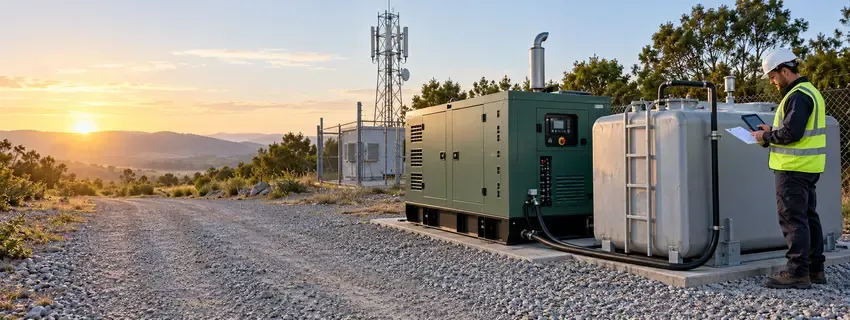
Communication base stations, data centers, and leased diesel generators are not typically started on a regular basis, but in the event of a power outage, whether there is enough diesel fuel and how long the generator can run directly impact business continuity. This article explains how to manage backup diesel fuel more effectively by addressing four key areas: routine inventory checks, preparations before a power outage, refueling during operation, and settlement of lease agreements.
How to Remotely Take Inventory of Diesel Fuel and Schedule Refueling for Backup Generators at Base Stations
Standby generators have one very typical characteristic: people rarely pay attention to them on a day-to-day basis, but when they’re truly needed, they can’t afford to fail in the slightest.
Communication base stations, IDC data centers, wind and solar power projects, and temporary construction power sites are often equipped with diesel generators or backup fuel tanks. During normal power supply, these generators may remain idle for weeks or even longer; however, in the event of a power outage, severe weather, or a grid failure, they must be brought online immediately.
The real problem is often not whether the engine can start, but rather the following issues:
- How much diesel is currently left at this site?;
- Based on the current load, approximately how much longer can it run?;
- Which stations should be prioritized for refueling;
- How much fuel was actually used during the power outage;
- Do the amounts of fuel added and consumed match?;
- What data should be used to settle accounts with customers for diesel generator rentals?
If all of this had to be done manually—by visiting sites in person or calling staff—it would not only be inefficient, but remote sites would also be prone to being overlooked.
Why do backup generators tend to “work fine under normal conditions but fail when it matters most”?
Standby generators are often left idle and are therefore more likely to be overlooked.
Some sites are located in remote areas, making it impossible for maintenance personnel to visit them daily; some fuel tanks are installed inside fenced-off areas or next to equipment rooms, where everything appears normal on the surface; and in some cases, leased fuel-powered machinery has already been handed over to customers for use, leaving the lessor with no choice but to wait for the customer to report the readings.
Problems typically arise in three areas:
1. Fuel levels are not inventoried on a regular basis
The system may still show that there is fuel remaining, but the actual remaining amount may have long since fallen below the safe reserve level. It is only after a power outage occurs and the generator starts up that it becomes apparent there is not enough diesel to last until power is restored.
2. The refueling records do not match the actual consumption.
Someone arranged for fuel trucks, and there were fuel delivery slips, but there was no continuous record of how much was replenished, how much equipment was actually added, or how much was subsequently consumed. Over time, it becomes very difficult to explain where the discrepancies came from.
3. Equipment that has been idle for an extended period has not been included in routine maintenance.
When storing diesel for extended periods, inspections and maintenance must be conducted in accordance with local regulations, fuel supplier recommendations, and on-site conditions. In addition to quantity, attention must be paid to the storage environment, moisture content, impurities, and the condition of the fuel. Having sufficient fuel does not necessarily guarantee adequate emergency reserves.
For day-to-day management, first categorize the sites by “risk level.”
Not all base stations and generators require refueling and inspections at the same frequency.
Administrators can first categorize the sites into several groups:
- Critical sites such as core communication stations and data centers that cannot be without power for extended periods;
- Stations in remote locations where refueling vehicles take a long time to arrive;
- Sites with frequent power outages or located in areas with severe weather;
- Generator rentals refer to equipment located at the customer’s site and used by the customer on a daily basis;
- Short-term projects such as temporary construction power supply and event support.
After allocation, reserve a higher safety fuel level at priority stations, while refueling ordinary stations according to the normal schedule. This ensures that fuel trucks, operations and maintenance personnel, and budget resources are prioritized for areas where they are truly needed.
During routine remote inventory checks, we look at more than just “how many liters are left.”
The most obvious figure in remote inventory checks is, of course, the remaining fuel level, but looking at the remaining amount alone is not enough.
It is more practical to frame this as a management issue:
- Is the current fuel level below this station’s safety threshold?;
- Based on the most recent actual fuel consumption during operation, approximately how much longer will it last?;
- Are there any refueling records for this month?;
- For equipment that has not been started for an extended period, check for any abnormal changes in fuel levels;
- Do you need to schedule a routine inspection or fuel test in the near future?
For example, a site’s fuel level may not appear to be low, but if it is in a remote location—where a refueling truck would take half a day to reach it—and the site is about to enter a season of heavy rain or high temperatures, its refueling priority may be higher than that of another site closer to the city.
This is the value of remote inventory checks: they don’t make decisions for people, but rather identify which sites need to be addressed first.
Before a power outage: First, determine “how long you can hold out”; don’t just check whether “the generator can start.”
Before typhoons, heavy rains, periods of high electricity demand due to extreme heat, or power grid maintenance, many companies conduct advance inspections of their generators.
However, performing only startup tests is not enough. You should also verify:
- Current diesel fuel level at the site;
- The device’s actual fuel consumption per unit of time in recent days;
- If the power outage continues, how long will it take for the refueling vehicle to arrive?
- Does the site have sufficient space and conditions to safely refuel?;
- Which key sites need to have their fuel levels topped off first?
Fuel consumption varies significantly among generators with different power ratings and load conditions. Do not simply apply a fixed “fuel consumption per hour” value. A more reliable approach is to refer to the unit’s historical operating records and then allow for a sufficient margin.
Power Outage: View Operating Time and Fuel Level Changes Together
After a power outage, when the generator begins operating under load, the management focus shifts from “inventory checks” to “ensuring an uninterrupted fuel supply.”
At this point, we recommend focusing on the following:
- Approximately when did the engine start running?;
- Does the current decrease in fuel level generally correspond to the operating time?;
- Which sites are seeing their available capacity decline at a faster rate?
- Which sites are closest to the refueling threshold;
- In what order should fuel trucks be dispatched?
If the fuel level changes significantly even though the generator has not been running for long, or if the fuel level continues to drop even though the equipment has been idle for an extended period, personnel should be dispatched to verify the situation. This could be due to normal operation, fluctuations in readings, or recording omissions; alternatively, it may indicate that the fuel tank, piping, or on-site management procedures require inspection.
Verify first, then make a judgment; avoid drawing conclusions based on a single piece of data.
After a power outage: Match “how much was replenished, how much was used, and how much remains.”
Once power is restored, many teams shift their focus to the next site. However, a post-outage review is often the most helpful step in preparing for the next emergency response.
It is recommended that, after each significant event, the following items be organized:
- Start and end times of power outages;
- Actual operating time of the engine;
- Fuel level before the power outage;
- Refueling volume and time during the period;
- Remaining fuel level after power restoration;
- Check for low fuel levels, abnormal fuel consumption, or delays in refueling.
After accumulating data over several cycles, the company will be able to determine more accurately: how much safety stock each site needs to maintain, which refueling route is the slowest, and which fuel-powered machinery has higher actual fuel consumption than expected.
Generator rental: Billing based on actual usage provides greater clarity.
Generator rental companies often face a common issue: after renting equipment to a customer, who is responsible for providing the diesel fuel, how much the customer has used, and how to calculate the remaining fuel.
If we rely solely on verbal reports from customers, disputes are likely to arise at the end of the month. A clearer approach is to keep records of fuel levels and operating times at key points such as arrival, handover, refueling, and departure.
This allows us to keep several things separate:
- What is the billing cycle for rent?;
- Which party is responsible for the diesel fuel?;
- How long has the equipment actually been in operation?;
- The customer has refueled several times on-site;
- How should remaining fuel be handled upon departure?
For lessors, this reduces the need for repeated reconciliation; for customers, it helps avoid disputes over fuel costs. Final settlement should still be based on the contract between the parties and local metering requirements, but comprehensive operational and fuel consumption records provide valuable supporting evidence.
Even for engines that haven’t been started for a long time, keep an eye on fuel level changes.
Many people believe that if a diesel engine won’t start, there is no fuel problem.
In fact, equipment that has been idle for a long time requires even more regular monitoring. This is because abnormal changes in fuel levels, tank leaks, and overlooked maintenance tasks often occur when no one is paying close attention on a daily basis.
For equipment kept in long-term standby, we recommend creating a simple routine checklist:
- Has the fuel inventory been completed this month?;
- When was the most recent startup test?;
- Are there any records of refueling or fuel extraction?;
- Are there any leaks, standing water, or safety hazards around the equipment?
- Is the condition of fuel storage being checked according to the maintenance schedule?
You don’t need to visit the site every day, but you shouldn’t wait until a power outage actually occurs before conducting your first inspection.
In which scenarios is backup diesel management particularly suitable?
This management approach is suitable for:
- Telecommunications carriers and base station maintenance service providers;
- IDC facilities, edge data centers, and data centers;
- Backup power for wind power, solar power, and energy storage projects;
- Support for construction sites, temporary camps, and outdoor activities;
- Diesel generator rental companies;
- Standalone power supply stations in remote areas.
The more sites there are and the more widely dispersed they are, the more evident the value of centralized inventory management and fuel replenishment scheduling becomes.
Frequently Asked Questions
Do I need to manage the diesel supply for a backup generator even when it’s not running?
Required. Even during long-term storage, fuel levels must be checked periodically, and the storage environment and fuel condition must be inspected according to the equipment maintenance schedule. Whether the equipment can operate when it matters most often depends on whether proper preparations have been made in advance.
How much fuel must remain in the tank to determine how much longer the engine can run?
There is no fixed answer. You should refer to the unit’s actual hourly fuel consumption under similar loads, and then make a judgment based on safety margins, the distance required for refueling, and the possible duration of a power outage.
If fuel levels drop suddenly, does that necessarily mean diesel has been stolen?
Not necessarily. It may be related to refueling, fuel withdrawal, equipment maintenance, changes in readings, or missing records. You should first verify the situation by reviewing the equipment’s operating status, on-site operations, and time records before making a determination.
Can we charge customers based on fuel consumption when renting out fuel-powered machinery?
Fuel levels and operating records may serve as verification references; however, specific billing methods, measurement standards, and the allocation of responsibility shall be governed by the contract between the parties, local regulations, and the agreed-upon settlement criteria.
Can fuel levels still be managed at remote base stations without a stable network connection?
Regular on-site inventory counts and manual inspections can be conducted; if continuous remote monitoring is required, first verify the site’s communication conditions and the transmission methods actually available. When network conditions are inadequate, a higher safety fuel reserve should be maintained, and inspection frequency should be increased.