FOFN Solutions
Agricultural Machinery Fuel Level Monitoring Solution: Prevent Fuel Shortages During Peak Farming Seasons and Keep Fuel Records More Accurate
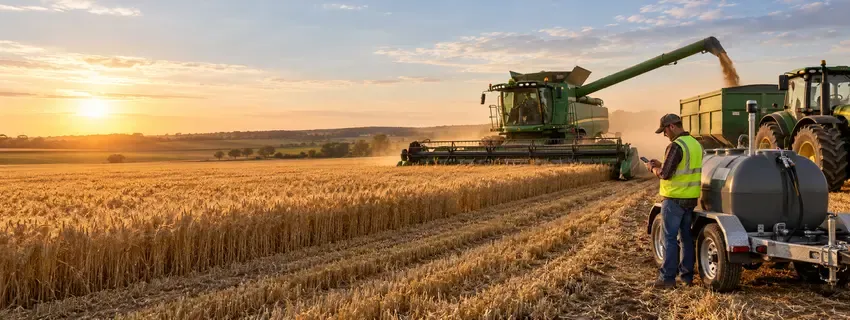
A fuel monitoring solution for farms, cooperatives, and agricultural machinery service teams. View real-time fuel levels, refueling status, and low-fuel alerts for harvesters, tractors, and trailer-mounted fuel tanks. This helps prevent fuel shortages during peak farming seasons, reduces fuel waste, and provides data for calculating operational costs.
Agricultural Machinery Fuel Level Monitoring Solution: Never Run Out of Fuel During Peak Farming Seasons, and Keep Better Track of Fuel Costs
When spring planting and fall harvest season roll around, farm machinery runs nonstop. Combines, tractors, and rotary tillers work in the fields during the day and are moved to new locations at night. The biggest concern isn’t the heavy workload—it’s running out of fuel mid-journey, mismatched fuel types, or diesel levels in the fuel tanks dropping without notice.
Many farms and cooperatives face a similar situation: fuel is “temporarily borrowed” from agricultural machinery tanks; the amount of fuel added by work crews is recorded only by hand; and once fuel tanks are taken to the fields with the vehicles, no one monitors the inventory in real time. By the end of a work season, it is often very difficult to reconcile the accounts.
FOFN’s agricultural machinery fuel monitoring solution integrates farm machinery fuel tanks, trailing fuel tanks, GPS positioning, and operating duration into a single management platform. Managers can see at any time how much fuel is left in each machine, which machines are running low on fuel, when fuel was last refilled, whether the auxiliary fuel tank inventory is normal, and approximately how much fuel was used on a particular field.
Applicable Scenarios
This solution is suitable for:
- Large Farms and Family Farms
- Agricultural Cooperative
- Agricultural Machinery Socialized Service Teams
- Agricultural supply service providers and mobile fueling service providers
- Agricultural Equipment Rental Company
- Equipment management for harvesters, tractors, seeders, rotary tillers, crop protection machinery, and other equipment
It is particularly well-suited for customers who have a large number of machines, operate over a wide area, and need to take equipment with fuel tanks into the field during the busy farming season.
What are the most common issues with agricultural machinery oil?
The farming season is short, yet the equipment is used intensively during this period.
The spring planting and fall harvest seasons are very short. As soon as the weather changes or the number of fields increases, the machines must operate continuously. If fuel supply cannot keep up, harvesters will be left idling in the fields waiting for fuel—which not only wastes time but can also affect the harvest progress for the entire field.
Remote areas lack permanent gas stations
Many agricultural machines operate in fields, mountainous areas, or remote townships where there are no nearby gas stations. Diesel is typically delivered by mobile fuel trucks or stored in tanks, and these tanks themselves also need to be managed.
If fuel is borrowed or siphoned off, it’s hard to clarify the situation afterward.
Agricultural machinery has large fuel tanks, and work sites are scattered. Some people temporarily draw fuel directly from the machines, while others pump it from storage tanks. Without proper records, it is difficult to determine afterward whether the fuel was used for normal consumption, transferred as part of routine operations, or lost due to abnormal circumstances.
There is no basis for subsidies and job settlements
Some farms and cooperatives calculate costs and settle service fees based on the area worked, time spent, or volume of work. If fuel consumption is based solely on estimates, disputes can easily arise regarding subsidy claims, lease settlements, and work crew management.
How is the proposal structured?
1. Fuel Level Monitoring for Agricultural Machinery Fuel Tanks
Install fuel level sensors on the fuel tanks of equipment such as harvesters and tractors to continuously monitor remaining fuel levels and changes in fuel volume.
The platform allows you to view:
- Current Fuel Level
- Fuel Level History Graph
- Refueling Time and Fuel Volume
- Record of Abnormal Fuel Level Decreases
- Low Fuel Level Alert
- Daily, weekly, and seasonal fuel consumption for different devices
Once the fuel tank has been calibrated, changes in liquid level can be more accurately converted into fuel volume data, which can be used for refueling verification and fuel consumption analysis.
2. GPS Positioning and Field Operation Duration Tracking
Once each piece of agricultural machinery is equipped with a GPS tracking device, the platform can not only monitor fuel levels but also track the equipment’s location, operating duration, and whether it is within the designated work area.
For example, when a combine harvester enters a field and begins continuous operation, managers can analyze the location track, ignition status, and fuel level changes to determine the machine’s operating duration and fuel consumption for that day.
This data is particularly useful for cross-regional operations, agricultural machinery rentals, and service team management.
3. On-Board Fuel Tank Inventory Monitoring
Agricultural machinery often needs to be taken to the field with a fuel tank to refuel. If this tank is monitored only by visual inspection, two problems can easily arise: first, no one notices when the fuel is running low; second, the fuel level has dropped, but it is unclear when the loss occurred.
Once fuel level monitoring is installed on storage tanks, inventory levels can be viewed in real time or at scheduled intervals. The platform can record:
- Current remaining fuel level in the storage tank
- Changes in inventory before and after each refueling
- Storage Tank Location
- Time of Abnormal Fuel Loss
- Low Stock Alert
This way, oil storage tanks are no longer an “invisible oil depot.”
Dual-Tank Solution for Agricultural Machinery and Fuel Tanks: How to Prevent Fuel Loss?
The dual-fuel-tank solution is not simply a matter of installing two sets of equipment side by side; rather, it involves ensuring that the data from both sides matches.
For example, if a fuel tank is 100 liters short of diesel at 3:00 p.m., while a nearby combine harvester’s fuel tank shows an increase of nearly 100 liters—and both are located on the same field—this constitutes a normal fuel replenishment record.
If the fuel level in a storage tank drops significantly, but there is no corresponding increase in nearby agricultural machinery fuel tanks, nor any records of normal operations by fuel trucks or staff, the incident can be flagged as pending verification.
Managers do not need to monitor the fuel tanks around the clock; they only need to focus on detecting abnormal changes.
Low-fuel-level alerts help reduce downtime due to running out of fuel during peak farming seasons
During the busy farming season, the worst thing that can happen is for a machine to run out of fuel in the middle of a job.
The platform allows users to set low-fuel thresholds for different devices. For example, when a harvester’s fuel level falls below the set threshold, the system alerts managers to arrange for refueling. This enables them to schedule fuel trucks or fuel tanks in advance, preventing equipment from being stranded in the field waiting for fuel.
Since fuel tank capacities, operational intensity, and refueling distances vary by machine, it is recommended to set reminder thresholds based on actual conditions; using the same value for all devices is not recommended.
How is fuel consumption data linked to the area of operation?
When assessing fuel consumption for agricultural machinery, it’s not enough to simply look at “how many liters were used today”; you must also consider how much work was done.
If a farm has data on cultivated areas, plots, or work orders, the following information can be analyzed together:
- How many hours did a particular combine harvester operate that day?
- How many mu or hectares does it cover?
- How much diesel was consumed?
- What is the approximate fuel consumption per mu and per hectare?
- Are there significant differences in fuel consumption among different operators and across different plots?
This helps farms estimate operating costs and provides a clearer basis for calculating agricultural machinery service fees, fuel subsidies, or internal settlements within cooperatives.
It should be noted that soil moisture, slope, crop density, load, and driving habits all affect fuel consumption. Therefore, this data is better suited for long-term comparisons and operational analysis rather than for evaluating a single operation.
What value does this solution offer?
Schedule refueling in advance during the busy farming season to minimize downtime.
Both the fuel levels in the equipment and the inventory in the storage tanks are visible, allowing managers to schedule refueling in advance rather than waiting until the machines run completely out of fuel.
Two-way verification of agricultural machinery and fuel tanks ensures greater fuel transparency
Fuel refueling for agricultural machinery and changes in storage tank inventory can be cross-checked. Records of where fuel is dispensed and which equipment it is loaded into are more complete, making it easier to investigate unusual losses.
Activity-Based Costing Is Easier to Calculate
By combining data on operation duration, plot size, and fuel consumption, you can roughly analyze fuel costs per mu of land, per machine, and per work crew, providing a basis for budgeting and settlement in the next season.
Reduce manual meter reading
There’s no need to check the remaining fuel levels at every machine and fuel tank every day. Managers can simply log into the platform to prioritize low fuel levels and unusual fuel level fluctuations.
A More Data-Driven Approach to Agricultural Equipment Rental Management
For agricultural machinery rental companies, fuel consumption, operating time, and work locations can serve as supplementary references for equipment handover and cost accounting, reducing disputes such as “There wasn’t much fuel to begin with” or “I didn’t use it for that long.”
Recommended Deployment Methods
When using it for the first time, we recommend starting with a small area:
- 2–3 key agricultural machines, such as combines and tractors
- 1 portable fuel tank or mobile refueling truck
- 1–2 primary operating areas
First, complete the fuel tank calibration, set the low-fuel threshold, and perform routine fuel refill verification. After one operational cycle, adjust the alert rules based on actual fuel consumption and operating habits for more stable results.
Frequently Asked Questions
What should you do if agricultural machinery is in a remote field with poor signal reception?
If 2G, 4G, or other cellular networks are available locally, the device can upload fuel level and location data at scheduled intervals. In areas with unstable signals, the device can temporarily store some data and upload it once network connectivity is restored. In scenarios with no network connectivity at all, a solution with local storage or short-range Bluetooth reading must be selected based on the project requirements.
Can fuel monitoring prevent fuel theft from agricultural machinery?
It cannot replace on-site management, but it can record abnormal drops in fuel levels, along with the time and location of such incidents. Managers can identify problems earlier and, by cross-referencing with on-site conditions, verify whether fuel has been siphoned, borrowed without authorization, or omitted from records.
Can oil storage tanks and agricultural machinery fuel tanks be monitored together?
Sure. That’s precisely the value of the dual-tank solution. The storage tank tracks inventory, while the agricultural machinery’s fuel tank tracks consumption and refueling changes; data from both sources can be used for cross-checking.
Do low-fuel alerts frequently trigger false alarms?
When configured properly, the system will not send frequent alerts. Since fuel tank capacities, operational intensity, and refueling distances vary by equipment type, we recommend setting alert thresholds separately for each equipment type and adjusting them after the equipment has been in actual operation for a period of time.
Can fuel consumption be calculated based on mu?
Yes. The platform provides data on fuel consumption, labor hours, and location; if the farm can provide the area worked or the order area, we can further calculate the approximate fuel consumption per mu or per hectare for use in cost analysis and subsidy calculations.
Is this also suitable for agricultural machinery rental companies?
Suitable. Lessees can view the equipment’s location, usage duration, fuel level changes, and abnormal events, which helps with equipment scheduling, handover, and operational management.