FOFN Solutions
Fuel Monitoring Solution for Mining Operations: Making Every Liter of Diesel Visible
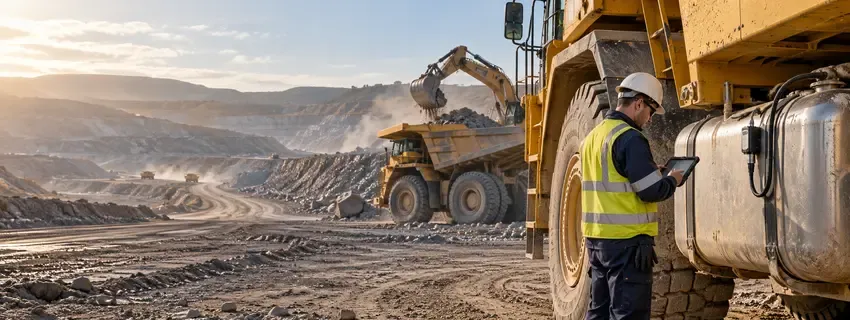
Fuel monitoring solutions for open-pit coal mines, metal mines, stone quarries, and sand and gravel aggregate plants. Using fuel level sensors, GPS positioning, geofencing, and operating hours/fuel consumption reports, these solutions help mining operations manage refueling records, abnormal fuel loss, equipment fuel consumption, and cost per metric ton of ore.
Fuel Monitoring Solution for Mining Operations: Making Every Liter of Diesel Visible
The oil used in mining equipment is not the same as that used in ordinary vehicle fleets.
For a mining truck, heavy-duty loader, or large excavator, monthly diesel costs can easily run into tens of thousands of yuan. With a large fleet of equipment, fuel expenses can quickly become the most difficult cost to manage in a mining operation. With vehicles operating across different mining areas, scattered refueling points, and long transport distances, relying solely on manual record-keeping means many issues aren’t discovered until the end-of-month reconciliation: it’s unclear how much fuel was added, it’s impossible to explain why certain vehicles have unusually high fuel consumption, and it’s impossible to determine why fuel levels dropped while equipment was idle.
FOFN’s mining fuel monitoring solution uses fuel level sensors, GPS tracking devices, geofencing, and a management platform to track “how much fuel was added, how much was used, where it was used, and whether there was any abnormal loss.” Managers no longer need to travel to the mining site daily to read fuel gauges; they can view fuel level trends, refueling records, fuel consumption, operating hours, and locations for each piece of equipment directly on the platform.
Applicable Scenarios
This solution is suitable for the following mining and heavy equipment operation scenarios:
- Open-pit coal mine
- Metal Mining
- Stone quarries, sand and gravel aggregate plants
- Quarrying and Earth Excavation Operations
- Mining dump trucks, wide-body trucks, loaders, excavators, scrapers, and road rollers
- Mining site fuel trucks, fixed fuel tanks, and temporary refueling stations
If the equipment is to be used underground, in goaf areas, or in other areas with explosion-proof requirements, the required explosion-proof rating, installation specifications, and certification documents must be confirmed before the project begins. Standard liquid level sensors cannot be used as direct substitutes for explosion-proof products; product selection must be based on the safety requirements of the mining site.
What are the main challenges in fuel management for mining operations?
1. High fuel consumption in a single device makes any anomaly immediately apparent.
Mining equipment operates under heavy loads for extended periods, resulting in high diesel consumption. The issue isn’t necessarily that “fuel is being stolen”; it could also be due to excessive idling time, differences in driver operating habits, changes in transport routes, or poor equipment maintenance.
Without continuous fuel consumption data, managers can only rely on refueling records and month-end total fuel consumption figures, making it difficult to determine which equipment is actually underperforming or consuming excessive fuel.
2. Refueling locations are scattered, making it difficult to reconcile records.
Mining sites may have stationary fuel tanks, mobile refueling trucks, or may require temporary refueling at different work sites. When refueling times, locations, and quantities do not match the actual changes in equipment fuel tank levels, it is often difficult to trace the information using manual ledgers.
3. Equipment is not centralized in one location, making manual inventory counts costly
Open-pit mining areas cover a vast expanse, with equipment distributed across mining zones, waste dumps, transport routes, and maintenance areas. Relying on manual meter readings every day is not only time-consuming but also prone to omissions. It is particularly difficult to verify fuel consumption changes during night shifts and shift changes.
4. Under heavy-duty operating conditions, looking at total fuel consumption alone is meaningless.
Even with the same 100 liters of diesel, the results vary greatly depending on how many metric tons of ore a vehicle hauled, how many hours it operated, and whether it idled for extended periods. What mining operations need to focus on is “the relationship between fuel consumption, output, and operating hours,” rather than simply how much fuel is left in the tank.
How is the proposal structured?
A basic mining fuel monitoring system typically consists of the following components:
Fuel Level Sensor
Installed inside or on top of a fuel tank, this device continuously monitors changes in fuel level. After tank calibration, the liquid level data can be converted into more intuitive fuel volume data.
It can help identify:
- Continuous Fuel Consumption During Normal Operation
- Fuel level rises rapidly during refueling
- Abnormal Fuel Level Decrease During Non-Operating Hours
- Prolonged idling or high fuel consumption
- Equipment with consistently low fuel tank levels
GPS Tracking Device
The GPS terminal supplements each fuel level data point with the time, location, driving status, and ignition status. This way, when managers detect an abnormal fuel level, they don’t just see that “fuel is missing”; they can also determine where the vehicle was at the time, whether it was in operation, and whether it had left the designated area.
Electronic Perimeter Fence for Mining Areas
Electronic fences can be set up on the platform to delineate mining areas, loading zones, unloading zones, maintenance areas, refueling points, parking areas, and more.
For example:
- When a vehicle leaves the mining area or enters a non-operational zone, a boundary violation alert can be triggered;
- Fueling records generated at fixed refueling points can be reconciled with the fueling ledger;
- If a vehicle parked in a parking area shows signs of significant fuel loss, it should be inspected as a priority;
- Labor hours, fuel consumption, and operational efficiency for different mining areas can be tracked separately.
Management Platform and Reports
The platform allows users to view device locations, fuel level graphs, refueling records, labor hours, and geofence events all in one place. Managers can export reports by device, work crew, date, or work area to facilitate monthly accounting.
How Fuel Monitoring Works in Mining Operations
Once the device is installed and the fuel tank has been calibrated, fuel level data will be continuously uploaded to the platform.
During normal operation, the fuel level curve will decline gradually; when the vehicle is refueling, the curve will rise significantly over a short period of time; if an unreasonable rapid decline occurs during parking, when the engine is off, or outside of operating hours, the platform can flag such events for management to investigate.
A valid fuel record should typically include the following information:
- Equipment Number
- Time of occurrence
- Current Location
- Data before and after changes in fuel level
- Is the vehicle in the ignition, driving, or parked state?
- Did it occur at a gas station, parking area, or outside a mining site?
- Corresponding work teams, drivers, or operational areas
- Does this require review and processing?
In this way, fuel management shifts from “reviewing a summary report at the end of the month” to “being able to monitor the process every day.”
Key Feature 1: Track fuel consumption based on operating hours, rather than just the fuel tank level
The production efficiency of mining equipment cannot be judged solely by how much fuel is added each day.
By analyzing equipment operating hours, operational status, and fuel consumption data, it is possible to conduct analyses that more closely reflect actual conditions:
- What is the average fuel consumption per working hour?
- Are there excessive differences in fuel consumption among similar devices?
- Whether a particular device has been idling for an extended period;
- Does a particular work team exhibit low productivity and high resource consumption?;
- Has fuel consumption improved before and after the equipment repair?;
- Does fuel consumption generally correspond to the volume of shipments and the volume of operations?
For mines with production data, it is also possible to conduct a “fuel consumption per metric ton of ore” analysis. Simply put, this involves comparing the amount of diesel consumed by the equipment with the actual production volume. Consistently high fuel consumption per metric ton of ore does not necessarily indicate an immediate equipment problem, but it certainly warrants further investigation into operational organization, equipment condition, and operating practices.
Key Feature 2: Three-way verification of refueling locations, fuel volume, and device fuel tanks
The biggest challenge in fuel management at mining sites is when data from both sides doesn’t match.
The system can designate fixed fuel tanks, mobile refueling truck stops, or temporary refueling areas as geofences. When a device enters a refueling area and a significant increase in fuel volume is detected, the platform can generate a comprehensive refueling record.
Managers can compile the following information for verification:
- Amount of fuel on the fuel receipt
- Time of refueling
- Refueling Locations
- Actual amount of fuel added to the equipment’s fuel tank
- Device Location and Status Before and After Refueling
The shape of the fuel tank, the vehicle’s tilt angle, and fluctuations in fuel level can all affect the data; therefore, calibration is required after on-site installation. The more thorough the calibration, the more reliable subsequent fuel refueling verification and anomaly detection will be.
Key Feature 3: Electronic Fencing for Mining Sites and Boundary Violation Alerts
Mining equipment should generally not be moved outside the designated work area without authorization.
Using geofencing, administrators can configure:
- Perimeter Fence Around the Mining Site
- Designated Mining Area Boundary
- Fueling Station Perimeter Fence
- Maintenance Area Fence
- Parking Area Fence
- Restricted Area
When a device crosses a designated boundary, remains in a non-operational area for an extended period, or experiences an abnormal drop in fuel levels while parked, managers can more quickly identify the devices that require verification.
Electronic fences are not intended to “monitor drivers,” but rather to provide on-site context for changes in fuel consumption and fuel levels. Knowing the device’s location at the time makes it much easier to assess many issues.
Key Feature 4: High-Load and Extended Idling Analysis
Mining equipment is designed for heavy-duty operation, but heavy-duty operation does not necessarily equate to high efficiency.
By combining ignition status, operating time, and fuel level changes, the fuel monitoring system can help detect:
- The engine has been running for an extended period, but the equipment is not actually in operation;
- If a device is operating continuously with high fuel consumption, should its maintenance status be checked?
- Fuel consumption varies too much among devices of the same model when performing similar tasks;
- Are there any abnormalities in fuel consumption during night shifts, shift changes, or before and after maintenance?
- After adjusting the transportation routes, has the fuel consumption per unit of labor time increased?
This data cannot replace on-site management, but it can provide a more solid foundation for it.
Value of the Solution
Ensure that “fuel consumption per metric ton of ore” is backed by verifiable data
By analyzing fuel consumption, labor hours, and production output together, mines can identify equipment or work crews that are low in productivity but high in consumption. As a result, decisions regarding scheduling, maintenance, and performance evaluations will no longer rely solely on experience-based judgment.
Reduce fuel loss and wasteful consumption
Refueling, fuel consumption, parking, and unusual fuel level drops are all recorded. For events that are clearly unusual, managers can verify them promptly, rather than waiting until the end of the month to discover discrepancies in fuel records.
Reduce manual meter reading and on-site visits
The platform allows users to view the fuel levels, locations, and operational statuses of multiple devices in one place. For projects with widely dispersed equipment and large mining areas, this significantly reduces the need for manual inventory checks.
Optimize Refueling Truck and Fuel Delivery Schedules
Once fuel levels for each piece of equipment are known, refueling can be scheduled based on priority, thereby avoiding repeated trips by fuel trucks and unexpected equipment downtime. For remote mining sites,合理安排 refueling routes can also reduce fuel loss during transit.
Provide a long-term basis for equipment management
The continuously accumulated data can be used to assess changes in fuel consumption, the effectiveness of maintenance, operational efficiency, and differences among work crews. It is not merely a tool to prevent fuel theft, but rather a data foundation for day-to-day operational management.
Recommended Deployment Methods
For customers new to fuel management in the mining industry, we recommend starting with a small batch of representative devices for a trial run, such as:
- 2–3 mining trucks
- 1 loader or excavator
- 1 fixed refueling station or 1 refueling truck
First, complete fuel tank calibration, refueling verification, and geofence setup. After running the system continuously for a period of time, adjust the anomaly thresholds and reporting criteria based on actual data. This approach makes it easier to build a solid foundation for the solution and helps avoid starting too broadly, which could lead to management issues down the line.
Frequently Asked Questions
Can fuel level monitoring still be performed if the network connection in the mining area is poor?
Yes, but the design must be based on on-site network conditions. In areas with strong 4G signal, data can be uploaded in real time; in areas with unstable signal coverage, the device can temporarily store the data and upload it once network connectivity is restored. For remote work sites with no cellular network coverage at all, solutions with local storage or Bluetooth data retrieval can be selected based on project requirements.
Can fuel level sensors in mines detect fuel theft?
It can help identify suspected cases of abnormal fuel loss, but determining whether it ultimately constitutes fuel theft requires verification based on a combination of time, location, vehicle status, the magnitude of fuel level changes, and on-site conditions. The system’s role is to promptly flag suspicious incidents, so that managers do not have to rely on guesswork.
Why is tank calibration necessary for fuel level data?
Fuel tank shapes vary by device, so the same change in liquid level does not necessarily represent the same change in fuel volume. Only after calibration can fuel level data be more accurately converted into liters for refueling verification and fuel consumption analysis.
Can standard fuel level monitoring equipment be installed in underground mines?
There is no one-size-fits-all answer. Underground mines, goaf areas, or flammable and explosive environments typically have specific safety regulations and explosion-proof requirements; product selection and installation methods must be determined based on local regulations, mining area standards, and equipment certification requirements.
Is it possible to calculate the fuel consumption per metric ton of ore?
Yes. The system provides relatively reliable fuel consumption and labor hour data; if the mine can provide data on transport volume, loading volume, or production volume, it is possible to further calculate fuel consumption per metric ton of ore for analyzing production efficiency and equipment operating costs.
Besides mining trucks, what other types of equipment can this be used with?
Loaders, excavators, scrapers, bulldozers, road rollers, drilling rigs, generators, fuel trucks, and stationary fuel tanks, among others, can all be configured with solutions tailored to their fuel tank specifications and usage patterns.